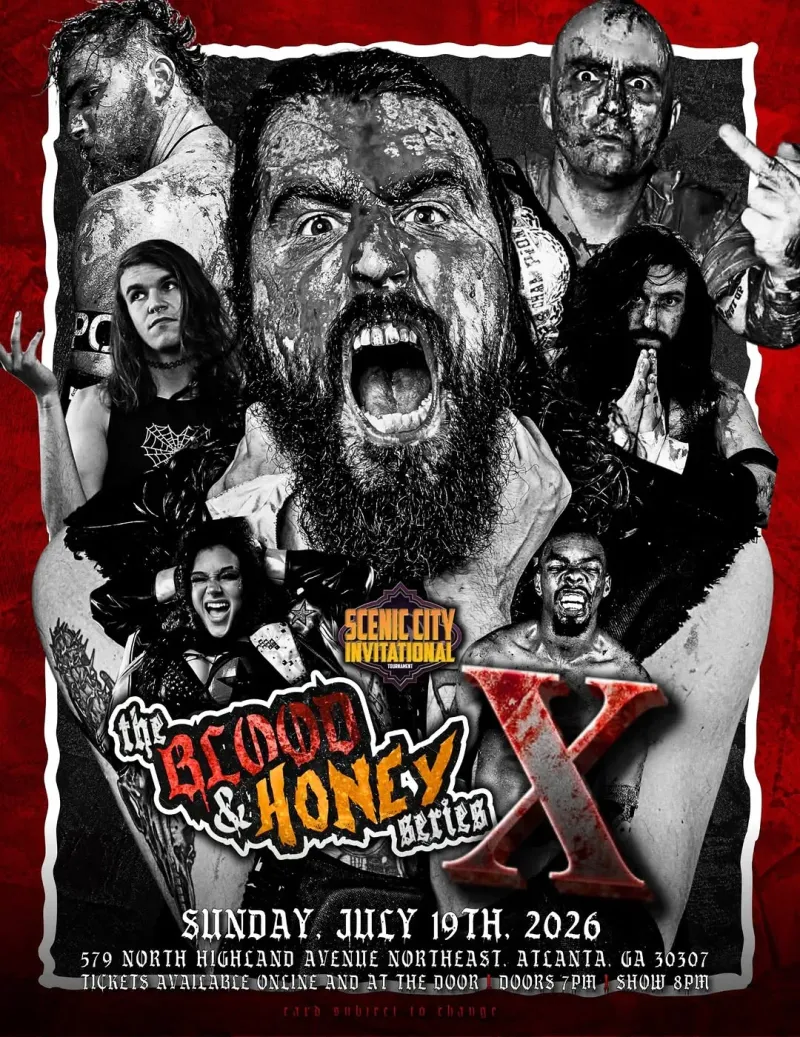
Blood & Honey is Nathan Mowery’s attempt to give Atlanta a deathmatch scene of its own. The series debuted outside Monk’s Meadery in October 2024 before somewhere between sixty and seventy people, the kind of intimate gathering of dedicated fans that’s perfect for the sort of atmosphere deathmatches thrive in. Less than a year later, its sixth show reportedly drew around 250. It remains a proudly homemade operation built around Southern wrestlers and local grudges, while bringing in specialists from the wider deathmatch scene. By Blood & Honey 10, what began as a small outdoor gathering beside a meadery has become a complete little deathmatch ecosystem, with recurring characters and ongoing stories presented confidently enough to make all the blood and broken glass look almost homey and mainstream.
I like the show’s cold opening. It has a retro-’70s B-movie slasher-horror vibe, complete with raunchy women holding knives. Between the matches, the lovely host Naddya delivers short segments explaining the context or history behind each fight. The power of 2020s technology, and knowing how to use it, is fully at work here. I have no idea what the budget was, but the show is remarkably easy on the eyes, even for viewers particular about wrestling production values.
Coven of the Goat vs. Top Team
Nathan Mowery & Tank vs. Neji Ichiban & Terry Yaki

Coven of the Goat attacks as soon as the bell rings and divides Top Team across two fronts. Mowery takes Terry Yaki into the crowd and beats him with a chair while Tank stays inside the ring to perform some creative hurting on Neji Ichiban. Repeated attacks to the groin, a bag of ramen noodles and some violent baking-sheet shots create the sort of funny and murderous opening that pulls the audience into the event. There is blood, but not yet the kind of gushing I really like. The comedy keeps the mood from becoming too dire while the blunt-force violence eases everyone into what will become a night of escalating carnage.
Mowery eventually sets up a table outside, which invokes one of wrestling’s oldest natural laws: he who sets up the table usually ends up on it. Terry Yaki climbs onto a nearby trailer and delivers a rolling senton that drives Mowery through his own construction. It gets the crowd popping and logically shifts control from Coven to Top Team. Ichiban and Yaki reunite inside the ring, put Tank through another table and hit him with stereo diving elbow drops from opposite turnbuckles. Tank survives, and even with the numbers in their favor, Top Team struggles to contain his raw power and resilience.
Unfortunately, the trailer senton also ends the match’s central appeal: the sense that two separate skirmishes are unfolding at once. The battle on two fronts disappears, and everything that follows becomes a linear accumulation of table spots and outside interference that does not always mesh. The valets trade some awful-looking punches before Tank throws Ichiban into them, sending everyone through a table. Mowery returns and plows through Top Team, eventually chokeslamming Terry Yaki onto another table covered with upright plastic forks. The plunder keeps escalating, but the match no longer has the same geographical structure or unpredictable movement that made its opening feel so lively to me.
The referee bump is where the convenience becomes especially difficult to ignore. The official did very little when the valets were fighting, so removing him does not meaningfully change the conditions of the match. Top Team ally Jazzy Yang then arrives with a referee’s shirt already in hand. Talk about lazy plot devices. Now, one can interpret this as Top Team trying to stack the deck with every possible advantage, but the preparation undermines the premise that the original referee was taken out accidentally. Ref bumps caused by accidental or incidental contact normally need time for the audience to register the implications. Here, there is no pause between the referee going down and Top Team’s own official coming in, so it takes away that sense of lawlessness and pandemonium that usually happens when a match loses its authority figure. The referee switch just feels convoluted and canned, which clashes with the chaotic and arbitrary nature established earlier.
Coven eventually neutralizes Yang and regains control before putting a member of Top Team through a burning table with an avalanche suplex to retain the titles. Fire is a natural final escalation for a match governed by tables, so the concluding image works. The route toward it is overly arranged, however, and the match abandons its strongest architecture: two distinct skirmishes unfolding at once, either of which might ultimately decide the outcome.
★★.75 — 2.75: They Almost Had It
Jamesen Shook vs. Sean Campbell

Jamesen Shook entering a deathmatch to Chappell Roan’s “HOT TO GO!” is certainly a vibe.
Anyone following the careers of both men knows that their bodies of work are impressive. These are two very capable professionals tasked with enunciating a more serious kind of violence that the first match purposely held back from doing.
Both men begin with some traditional wrestling, a useful reminder of their high skill level, as commentary points out. Really, though, the wrestling is but a quick cold open before they go straight for the weapons. A weird-looking wooden rack stands inside the ring with several light tubes attached to it. Unsurprisingly, it introduces the thematic weapon of the match: light tubes. Shook breaks some of them over Campbell, but their uncomfortable proximity to the crowd probably forces him to mitigate the impact, so the tubes do not produce the kind of explosive force one normally gets from such a spot.
We then get some very diligent scraping action as Shook drags a broken tube across Campbell’s forehead. Man, the blood that comes out is pretty intense. It has that lovely deep-cherry-syrup appearance that greases up Sean’s Jack Perry hair.
A good portion of what follows belongs to Shook. He controls the match’s tempo through several creative uses of the numerous light tubes at their disposal. He finds different ways to keep Campbell trapped inside his makeshift kill zone.
Shook eventually brings out some exotic plunder: a customized rake with five light tubes attached to it. Fortunately, Campbell makes his comeback and turns the weapon against Shook. Campbell gets a brief period of offense to make up for Shook’s brutal slaughterhouse domination. It’s all meat-puncturing, flesh-flaying fun, but once they return to the weird rack held together by light tubes, the match begins to spiral and unravel.
Campbell attempts to position Shook in the center of the contraption, but Shook recovers and hits the mounted Campbell with an avalanche assault driver from the top rope. The setup is so noticeably tedious that it derails all the tight momentum they had built throughout the match. Even the fans become impatient and start heckling them. The frustrating part is that these two wrestlers are talented enough that you don’t need to buttress their match with a clunky contraption climax. Just their skills and some more scarring would have been good enough for the finish.
That final minute and a half deflates the whole thing, which is a damn shame because there are some genuinely gore-slicked moments in this one that kept me entertained. Oh well. Let it be a cautionary tale, then: one clunky climax can undo all the good work that came before.
★★.75 — 2.75: They Almost Had It
Spectre vs. Keelin Cole

The match is preceded by a grumpy and bitter Spectre vignette. He is pissed off that he is not getting the love he deserves. He announces that he will take his anger out on Keelin Cole and ACTUALLY DRIVES OFF ON A JET SKI headed for Atlanta, where Blood & Honey is being held.
Maybe they do have a sizable budget.
This is a contest to prove who is better, and their opening wrestling gives us a useful glimpse of the difference between them. Cole is quick and athletic, while Spectre is strong enough to regain control with a deadlift wheelbarrow German suplex after Cole tries to drive him into a barbed-wire board. They hardly give that wrestling time to settle before bringing out a light tube, though. Cole turns the weapon against Spectre and cuts his forehead with it, so we have blood barely a minute into the match. From there, the pace slows as Spectre takes over with a rather weak chair shot and a Boston crab that Cole has to fight his way out of.
Cole’s next comeback gives the violence a more pronounced shape. He crotches Spectre on the top rope when a bit of rope-walking bravado goes wrong, then sends him outside with a dropkick and follows him with a suicide dive. Back in the ring, Cole drives him onto the barbed-wire board with a Death Valley Driver. There we fucking go! Spectre tangled up in barbed wire is the money spot, and the match finally gives us something more substantial than its hurried early tour of the available plunder.
Spectre’s best idea comes when he places one chair upside down on another, bringing their seats together to form a thicker steel surface, and suplexes Cole onto it. It is a nasty-looking bump to Cole’s back, and it should affect his decision-making for the rest of the match. When Cole later tries to suplex Spectre, however, Spectre stops him with a low blow. Honestly? That turned me off. Cole failing because his back still hurt would have been a much better consequence of the chair spot. They already sold us on the damage. Using a low blow to hinder Cole’s momentum instead of developing the little story arc surrounding his back smacks of negligence.
Spectre tries to bring in a glass pane, but it breaks in his hands before he can set it up, so he whips out one of those five-foot-tall PVC Batman statues you see in hobby shops. He hits a middle-rope splash while holding it, which at least gives the strange thing a purpose, even though I’m not especially taken with the spot. Spectre then moves on to a ladder, but Cole greets him with a dropkick and leaves him wedged between the ladder and the corner. Cole follows with a volley of shotgun dropkicks into the ladder, crushing Spectre in the process. I hate to be a stickler for detail, but each one sends Cole crashing onto the lower back we just watched get slammed into metal. He shows so little of that damage that the suplex onto the chairs begins to lose its weight. Because of that, everything afterward flits between looking gritty and produced: we know he’s supposed to be hurt, but he doesn’t seem hurt. How hard is it to just sell the fact that you suffered trauma to your lower spine?
Anyway, they manage to build to a proper finish. Spectre stands the ladder and balances another glass pane across two chairs; Cole fights him onto it, and they eventually struggle at the top of the ladder. Cole brings Spectre down with a blockbuster through the glass for the win. It is a serviceable conclusion to a match plagued by a pace that seems impatient at times. The match has worthwhile ideas and a finish that brings all its plunder together, but its uneven pace and disregard for Cole’s back keep all that violence from accumulating into something more.
★★.50 — 2.50: Respectable, But Limited
Corinne Joy vs. Grayson Pierce

Intergender matches usually take one of two approaches. Either the wrestlers disregard the disparity between the sexes and treat each other as equal combatants, or they acknowledge the physical differences and build around them, producing a David-versus-Goliath contest rooted in sex.
This match belongs to the second category. Corinne uses her agility early to avoid getting tangled up with Grayson. She is constantly moving and forcing him to follow, preventing him from setting his feet, establishing his base and using his advantage in size and weight to overpower her. Keeping the fight mobile still costs Corinne energy, but it’s better than fighting a centered Grayson because, on the few occasions when they lock up in a static way, he obviously overpowers her. Her hope is that Grayson’s larger frame pays a heavier price for all that chasing and resetting.
They never go heavy on the brutality, but the match nevertheless settles on a clear identity. It is important to consider the pre-match brouhaha because the context anchors the entire match. This is a lovers’ quarrel, so the purpose is not the complete destruction of either party. Grayson doesn’t want this match, but Corinne wants to prove her point. Each sequence becomes an attempt to humble the other and establish control. Nearly everything they do aligns with that central intent.
Once they bring out the chair, the violence picks up the pace. They exchange careful shots to the head. They do that spot so popular in mainstream wrestling now, where one person superkicks the chair into the other person’s face. Then they end up on the apron wrestling for control of it. Corinne even takes a nice springboard kick while holding the chair close to her face.
Both wrestlers spend much of the match attacking each other’s backs. They balance a wooden board or a steel chair across two other chairs, then hit backbreakers and slams onto it. There is a very beautiful part where Corinne powerbombs Grayson from the top rope unto the board balanced across the chairs. It is cleanly and convincingly done, with neither hurry nor panic.
Eventually, the parties incorporate light tubes into the violence. That also helps to get some blood going. What I like about the match is that it consciously maintains the idea that the fight is emotionally charged. As Grayson loses his temper with every painful blow he receives, his attacks become more malicious. Whereas Corinne becomes more frantic and frustrated, and just a little bit hurt that her man would rather take a chair shot to the head than kiss and make up.
The finishing sequence features a giant glass pane covered in graffiti. Whether on purpose or by accident, the glass never breaks, no matter how many times Corinne slams Grayson into it. It was alright; it played on the match’s physical theme of attacking each other’s backs. Corinne wins, giving this fight its bitter but definitive conclusion. The match has the discipline to pick an identity and stick to it. We get some very timid bleeding and very in-your-face back-centric offense. It feels angry and furious and lively compared to Cole versus Spectre, but it never gets out of control like the first two matches.
A fight that could have been avoided with some TLC: tender loving care, of course.
★★★.50 — 3.50: Marquee Main Event
Anakin Murphy vs. Sicko the Clown vs. Dimitri Alexandrov vs. Matt Griffin

This match offends, or challenges, my understanding of the logic behind fatal four-ways. A fatal four-way supposedly allows the wrestlers involved to hide each other’s weaknesses and enhance each other’s performances. Unlike a triple threat, it can also accommodate mini match-ups within the match itself, along with the usual tropes of temporary alliances or several wrestlers ganging up on the strongest one. The problem here is that the match does not seem content with the ingredients at its disposal and keeps adding more, resulting in a case of too many cooks ruining the soup.
Here we have four players, all of whom are familiar with the deathmatch scene. Anakin “Deathwish” Murphy is a very young and highly skilled babyface on the independent scene, while Dimitri Alexandrov is known as Deathmatch Jesus and is a highly acclaimed deathmatch champion and specialist. His résumé is worth a very good look. Sicko the Clown is the hot new rising star who brings that unpredictable, explosive danger with him, and Matt Griffin runs ACTION Wrestling, which he founded, while playing Blood & Honey’s self-appointed Deathmatch God. Don’t let their unassuming appearances fool you: these are four fundamentally grounded wrestlers who just happened to develop a taste for the darker pleasures of deathmatches. They are more than capable of telling a wristlock from a wristwatch.
The match opens with some good wrestling. They lean into Matt Griffin being a universally hated person in the context of this show, and the very pretty Naddya does a good job conveying how hateable Matt is, so the wrestlers all sort of gang up on him. Anakin and Sicko make quick work of throwing Matt and Dimitri out of the ring. They square off for a bit, but Matt makes his way back into the ring and disrupts their duel. He’s the obvious bruising powerhouse in this group. Dimitri equalizes things, though, by whacking Matt on the head with a fat light tube.
This match is paced aggressively. Within a few minutes of the bell, all parties are dripping with blood. Either they get hit with a weapon or they cut themselves on the hundreds of tiny pieces of glass on the mat. Anakin Murphy’s girlfriend gets involved and confronts Matt Griffin. She gets rewarded for her bravery with a punch and a gusset plate stuck to her head. Immediately after, the various seconds get involved: the Young Boys on behalf of Matt Griffin and Sadistico for Lil Sicko. They even have a great spot where Lil Sicko does the 619 on Matt Griffin and a Young Boy while a light tube is wedged between them.
That entire sequence is exactly what I dislike about the structure of the match. It is too early in the match for the seconds to get involved, and there was no urgency presented to justify such a clunky, very sports-entertainmenty interference sequence. The match has barely established its four wrestlers, and then it complicates things by introducing more warm bodies for the audience to take note of.
Matt Griffin, as the obvious heel, is so good at controlling the flow. Little things like barking back at the crowd or violently hitting a woman in a very cold and dispassionate manner that reeks of the vilest kind of misogyny make Matt such a force of gravity. I found the part with the attack bats lame, but I appreciate how Matt rolls with it in a very playful and cartoony way. He eats up the scenery but never forgets to really hit his strikes and do his spots with such believable, rough physicality.
Anakin Murphy and Dimitri work this match as utility guys. You hardly feel Dimitri. It’s like he’s really just there to take that spot involving the table with barbed wire on it. Anakin feels like the feisty babyface who never got enough time and focus to really develop. I thought the ultimate showdown was going to be him and Sicko, but they never moved in that direction.
Lil Sicko, for his short bursts of brilliance, really shines through as the most important piece in this match. It’s not just the crazy spots he does, such as the Coup de Grâce on a skateboard from the top rope, or the very nasty fall he takes onto a giant glass panel. It’s also how he looks in those moments. He knows he’s a star and embraces the mantle of being one, whether it’s in the way he interacts with the crowd or how he does the little things, like climbing up the turnbuckle. He can feel each moment, as cliché as that may be, and he takes his time with a kind of poise that is beyond his years.
The size and scale of this match are deceptive because they give the impression that it’s going to be a long day in the trenches, with all four men killing each other in creative ways. Instead, the finish arrives abruptly and results in Anakin Murphy eating the pin and Matt Griffin walking away with the win. Now, longer matches don’t necessarily equate to better matches, but in this case, they could have used more time to really give everyone distinction. Sicko and Dimitri feel especially underused, and Anakin Murphy never gets to develop any momentum even though he’s presented as someone more important.
At the end of the day, it’s all about that bastard Matt Griffin!
★★★ — 3.00: Complete Professional Wrestling
Hardcore Hillbilly vs. Mr. Danger

Hardcore Hillbilly and Mr. Danger both came through Atlanta’s WWA4, but arrived at this main event by different routes. Hillbilly has become one of Blood & Honey’s familiar faces, while Danger has taken his aerial offense and appetite for deathmatches onto a wider independent circuit. On paper, their contrast gives the match a simple shape: Hillbilly has the size and power to bully Danger, who has to find openings without letting the larger man get hold of him.
They begin with headlocks and a quick roll-up before Hillbilly throws Danger with a backdrop suplex. That one move tells us plenty about the physical mismatch. When Danger tries to use a bundle of light tubes, he cannot break them over Hillbilly, who takes the bundle and smashes it across Danger’s head instead. Once outside the ring, they engage in a very sloppy sequence where Danger blatantly cooperates by letting Hillbilly lift the back of his shirt so that Hillbilly can hit him with a tube. It’s utter trash, and it’s the sort of laziness that takes away the feeling of desperation and depravity that a good death match should capture.
Hillbilly tries to give the match a more promising direction by attacking Danger’s leg with a crutch and working toward a figure-four. Danger pushes him out of the ring before Hillbilly can apply it, then immediately gets up, grabs more tubes and launches himself through the ropes in a suicide dive. He follows that with another aerial attack once Hillbilly is back inside. I can accept a wounded man defying pain and fear, but Danger moves as though Hillbilly’s leg work has simply vanished. The match introduces a physical conceit and then quickly abandons it, instead of cultivating what it means for the rest of the match. Like seriously, what happened to causal logic in this event? It feels more obligatory than natural to the wrestlers involved.
From there, the spaces between the spots become thinner. Some of the execution is rough, including a tackle that never looks as though it could reach Danger and yet another tame chair shot. If the chair shot can’t be done with the kind of clanking force it deserves, then better not to do it. A death match should have enough creativity that it doesn’t have to rely on watered down plunder.
Hillbilly puts him through a table outside, and the referee begins a count while both men are down. When Hillbilly recovers, he tries to pin Danger on the floor before bringing him back into the ring. Even commentary seems unsure whether a fall can be made outside. Discombobulating slips like this serve as a splash of water to the face of an otherwise immersed audience. It’s truly negligent stuff that you can’t unsee and the wrestlers can’t hide anymore. And you can gather that much from the audience as well: there’s none of that raucous cheer and fan frenzy that serenaded the previous matches. Oh sure, the crowd will pop every now and then for a spot, but the awkwardness of the match’s structure derails any momentum of the crowd going supernova for the fucking main event of all things.
The closing stretch has plenty of apparatus, but there’s little struggle over it. Hillbilly sets a barbed-wire board in the corner, and Danger avoids being driven into it before dropkicking him through it instead. It is the most telegraphed sort of matador spot; a little jostling for control might have made the danger more credible and less planned. Danger then places a glass pane over Hillbilly and hits a coast-to-coast, but it refuses to break, even after a chair shot. Hillbilly eventually breaks it with a cannonball onto Danger in the corner. Danger scarcely carries the effect of that impact into the finish: he quickly catches Hillbilly with a DDT, neatly lays light tubes across him and wins with a 450 splash. Mind you, he did all of that with the hurried look of someone setting up a spot, as opposed to a wrestler fighting tooth and nail to win!
There are individual bumps here that ought to feel consequential, yet the match keeps rushing past them. The lack of connective tissue, especially its failure to consistently follow the logic of Danger’s injured leg, prevents it from being the sort of mature narrative befitting of a main event.
★.50 — 1.50: Blueprint Fracture
The Verdict
Blood & Honey 10 is a decent event. The pre-match recaps and the earnest effort to give it a more commercial polish distinguish it from your typical deathmatch show, which tries as much as possible to look like an abattoir. Sadly, the curtains match the rug in this one, because the matches are too overproduced and too polished. Most are obsessed with getting their spots in at the expense of credible danger and a disciplined adherence to consequential logic. Corinne Joy and Grayson Pierce are the welcome exception. It’s weird to say this, but the event feels like a community theatre version of a deathmatch. I wouldn’t be surprised if the local deli guy supplied some of the plunder. It does give off that family-and-friends-outing atmosphere, and the matches seem structured primarily to entertain through shock.

But here’s the thing: a great deathmatch isn’t supposed to be entertaining. It’s supposed to be guttural and archaic and disturbing. The great ones, the memorable ones, inspire the basest and most grisly feelings in our hearts while still maintaining their focus as athletic wrestling contests. That’s where the real entertainment comes from: the guilty pleasure of realizing we can like this butcher’s ball we’re watching and still believe it’s pro wrestling.
Blood & Honey is fun, and it’s presentable, but it can’t hide its shallow nature with F-bombs and tiny slices and cuts to the face. It’s a good entry-level event if you just want some blood and broken glass.


Leave a Reply