Cannon to right of them,
Cannon to left of them,
Cannon in front of them
Volleyed and thundered;
Stormed at with shot and shell,
Boldly they rode and well,
Into the jaws of Death,
Into the mouth of hell
Rode the six hundred.
— Alfred, Lord Tennyson, The Charge of the Light Brigade (1854), Stanza III
The WarGames stipulation is everything colorful, special and unique about professional wrestling. It’s flamboyance being used to present a very guttural and timeless story of enmity exploding into violence.
But don’t let the fancy cages and the tabletop-style rules give you hesitation. The rules are actually very simple. The problem is that, historically, bookers don’t do what they say and they say things they don’t do. Flashing the rules on the TV screen or having an announcer explain them means jackshit if you’re not going to own up to what those rules entail.
Fortunately, this match lives up to its rules in a way that makes it the standard for WarGames, bar none. Yes, you heard that right, you Black and Gold marks.
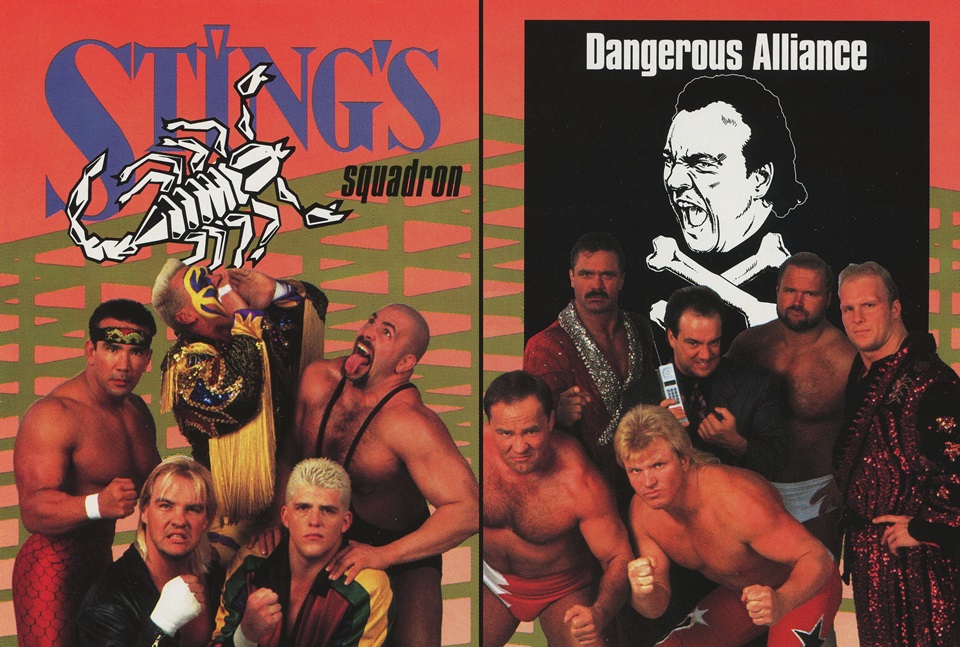
By May 1992, WCW had spent months building Paul E. Dangerously’s Dangerous Alliance into the company’s dominant heel coalition. Rick Rude had already taken Sting’s United States Championship after targeting his knee, while Steve Austin, Arn Anderson, Bobby Eaton and Larry Zbyszko gave Dangerously enough depth that the group could threaten practically every major babyface in the company. Sting eventually answered with a squad of his own: Barry Windham, Dustin Rhodes, Ricky Steamboat and, most intriguingly, Nikita Koloff, whose uneasy relationship with Sting gave the team one unresolved problem before they ever stepped inside the cage. WrestleWar brought all of those feuds together in WarGames on May 17, 1992, with Sting returning from roughly a month away and the match effectively serving as the grand collision between WCW’s franchise player and the faction that had spent months trying to dismantle his side of the promotion.
All of that tension and intrigue is bottled up into this match. A good WarGames match is one that captures both the spirit and the letter of the law, and then applies those rules to the brutal physical architecture of two rings enclosed inside one giant steel cage.
What are the governing rules of WarGames? You have ten men participating in the match, but you can’t just throw all ten of them in there at once or else you’ve basically created a battle royal with better furniture. So one man from each team starts the match and fights for five minutes. After that, a coin toss determines which team gets the advantage, and one member from the winning side enters the cage, creating a temporary two-on-one.
Two minutes later, the disadvantaged team sends in another man to even the odds. From there, the teams alternate entries every two minutes until all ten wrestlers are finally inside the cage. And here’s the kicker: nobody can actually win during that whole stretch. The real WarGames, where winning becomes the point, only begins once every participant has entered.

It’s a very smart way to control pacing and tell stories within the story. The most important story being about numerical superiority. Since winning isn’t an option until everyone has finally entered, the goal of either side is to use numbers to do as much damage as they can to their opponents. If you’re the side with the edge of getting your guys in earlier, then every period when you have that additional person is an opportunity to press the advantage and bust someone open or injure a limb. If you’re the side playing defense, all you can really do is stand your ground, take your beatings with some dignity, and pray that the clock ticks faster for your buddy to come in.
Aside from its very straightforward rules, the other defining half of WarGames is the hellish architecture of the cage. There’s a certain charm to the shoddy engineering of WCW’s cages. The apron has a narrower design, which means the cage walls are almost sidling up to the ropes. It’s such a glaring detail, but in a good way, because it reinforces the tight and compressed landscape. When wrestlers try to run the ropes, they can’t lean on them too hard, otherwise they’ll hit the cage walls. The design discourages wide rope-running and keeps pulling the action back toward the center, the corners and the steel.
And speaking of which, first-time viewers will probably find it very jarring that the cage’s ceiling is surprisingly low. It’s a far cry from the roomier build used by WWE. In WWE, the cage is there to keep the fighters from leaving, but it also rewards innovation because the structure lets wrestlers climb up and get some aerial offense. In WCW, the cage isn’t built for creative thinking; instead, it purposely traps the players and limits their offense to dueling across the two rings. Whether that’s by design or by accident, it works well and comes together with the system of rules to promote as much brutality and bloodshed as possible.
All of the aforementioned shines through triumphantly here. Barry Windham and Steve Austin start the match on even footing, which is exactly what WarGames needs before the stipulation begins tilting the floor beneath everyone’s feet. For five minutes, there is no numerical advantage and no teamwork to rely on, so we’re treated to as standard a fight as possible. This brief quiet before the storm gives the match a clean baseline before shit starts happening.
Windham and Austin make very good use of that baseline because they don’t wrestle as though the cage is just there to look imposing. Almost immediately, the steel starts becoming part of their offense. They ram each other into it. Fucking scrape against it. They use the cramped space to make ordinary exchanges feel nastier than they would in an open ring. The craziest thing about these old WCW cages is that they don’t have the Lego-looking design that WWE uses. It really looks like one of those old chainmail-mesh rat traps with the trapdoor. The steel itself gives the impression of being poorly cut, like there are small serrations probably sticking out.
Austin gets busted open early, and that matters a lot because WarGames needs to really be in your face with the damage. If all the violence before the Match Beyond disappears the moment another wrestler enters, then the whole structure starts feeling performative and the lull moments start becoming noticeable. The blood keeps the violence present even when the action slows down. Because truthfully, in wrestling, a bleeding person will always be a cause for commotion. Austin can be standing around catching his breath and the match still looks like something terrible has already happened to him.
The opening period also gives us something important about Windham. He isn’t just killing time until the first countdown expires, either, because he is actively trying to soften Austin up while the fight is still fair. It’s a crafty little detail and a reminder that Barry has considerably more mileage than Austin, including his time riding with the Horsemen. He knows the fair portion of this match has an expiration date, so he uses every second of it. He’s giving it to Austin in such a way that Jesse ‘The Body’ Ventura bemoans to JR that the whole thing is woefully unfair.
Once the coin toss goes the Dangerous Alliance’s way and Rick Rude enters, it turns south for Barry. Windham has lost the luxury of dominating this exchange. He is now trying to survive two men in a cage until backup comes to even the odds. Rick Rude is just so badass, for lack of a better term. He comes in there, he’s not trying to wrestle Barry, he’s throwing hard-looking punches and he’s really working him the fuck over. It’s a good way to really convey that Windham is a large guy—6’7″, apparently—and chopping him down is what’s best for the Dangerous Alliance.
Rude and Austin make a good meal of the two-on-one for whatever time they have left. They crowd Windham and strangle whatever space he has left. They keep boxing him into ugly little exchanges where size stops mattering because there are simply too many hands being thrown. This is where the WarGames format really earns its place as a storytelling device because Barry isn’t getting his ass kicked because Rick and Austin are better wrestlers, it’s just simple math that two is more than one. But as the rules provide, these things never last.
Enter the fucking Dragon (yuck, but I had to use it). Rick Steamboat comes in to great fanfare and starts lighting them up with some gorgeous-looking haymakers and a pair of spiteful DDTs. That’s another thing this match understands really well: every new entrant should feel like something has happened, and the presentation and commentary do a good job of capturing that seismic jolt. When Steamboat comes in, it’s not just another vanilla sequence of him distributing punches between Austin and Rude. He comes in there with pomp. He’s so angry and so animated with that anger that it’s like he just watched his wife get mugged or something. I love the sight of him just celebrating with rage and adrenaline. Goddamn, Ricky!

One thing to note with this particular WarGames is the assembly of talent on both sides. In terms of star power and in-ring work, this is one of the most balanced rosters in the history of the WarGames format, WWE era included. Some years had too much star power but left a lot to be desired in the ring, while others had good working players who just couldn’t grab the kind of attention you’d want. Most of the guys here were heavy-hitters with medals on their chest from the glory days of the old territories, while Austin and Dustin were the younger blood proving they belonged in the same cage. Austin, in particular, makes up for whatever experience he lacks with some very good pre-neck-injury bumping and plenty of blood gushing early on.
For a brief stretch here, the numbers are even again and the babyfaces can breathe. Windham no longer has to survive by himself, which is good because he’s busted open as well. Steamboat gives the match a different kind of speed and movement. He’s less lumbering than Barry and more willing to bounce between targets, and that comes in handy for a match where the battlefield keeps changing every few minutes.
There’s also a nice little bit of strategy here that comes naturally with the WarGames format. Austin had to learn about the limitations of that low ceiling while already trapped inside the cage, but Steamboat has had the benefit of watching all of this from the outside. By the time his turn comes, he already knows that the roof can impede the sort of vertical offense he might normally use, so he adjusts accordingly. That’s an underrated wrinkle of the staggered entrances: the wrestlers can scout for the tendencies of their opponents. Every person who enters later has had a little more time to watch the cage punish somebody else and tinker with what they intend to do once the door opens.
The whole thing feels less concentrated now because you have two sets of guys brawling all over the place. That temporary relief doesn’t last, of course. Arn Anderson is next for the Dangerous Alliance. ARN ANDERSON. I’d give this man the shirt off my back even if he was already wearing one. When I was getting into the Territories, he was one of the guys I quickly gravitated to, mostly because I grew up with memories of his spinebuster to Taker, but also because he works with such economy and has that nightclub-bouncer look that gives real life to his moniker, “The Enforcer.” Talks well, wrestles well, and looks like a mean fellow, and oh, did I mention he has the best spinebuster in the game? And once he gets inside, he immediately gives the Dangerous Alliance a sense of order and command. He cracks Barry good with a DDT, then heads over to Steamboat and puts him down with said best spinebuster in the game. Just like that, the Dangerous Alliance is back in the driver’s seat.

Dustin Rhodes comes in next and, much like Steamboat, he’s wised up to the sort of action to expect once he’s inside. He gets Austin up high enough to smack his head into the roof, then later hoists him up again and drags the poor bastard’s skull across the ceiling. It’s such a nasty use of the cage that by now the roof has gone from something that’s boxing them in to something that’s squeezing out all their most intrusive, sadistic thoughts. That progression does more for the stipulation than any amount of commentary screaming about the dangers of the cage.
From here the match gets increasingly difficult to describe without sounding like a police report because the pace picks up considerably. Larry Zbyszko enters, Madusa climbs the cage and manages to feed Paul E.’s hilariously enormous cellphone inside, which Arn promptly uses because apparently a cage already full of angry, brawling wrestlers still needed violence. It’s a dumb spot, if you ask me. It doesn’t change the complexion of the match. The only great thing about it is that when Madusa climbs on the ceiling, you can see the cage strain under her. It really adds to the feeling that the cage is unwieldy and collapsible, and that gives it a distinct character.
Sting finally gets his turn, and his entrance feels appropriately bigger than everyone else’s because this is his war after all. He comes in with those wonderful Sting bursts of frantic athleticism, starts clearing bodies and eventually gets Rude over his head so he can repeatedly press him into the ceiling. Mind you, repeatedly press him into the ceiling. Yeah. Sting could do that. For readers who only know him from his Crow run, Sting was the WCW Cena, replete with all the physical tools to be your kid’s hero.

By this point there are bleeding men scattered across two rings, bodies crashing into the walls and various smaller fights blazing across the land wherever the camera decides to look, so trying to follow every exchange almost becomes beside the point. The match has hit its desired cliché of ‘erupting into chaos’. It’s a testament to the skill of the men involved that the whole affair never feels like a bunch of wrestling sequences happening, they really make it look like it’s just all these men pawing at each other in a godforsaken contraption.
Bobby Eaton entering gives the Dangerous Alliance its last numerical advantage, and somewhere amid everything else Rude and Zbyszko begin fucking around with the turnbuckle, which is important enough to remember but thankfully not important enough for the match to stop and fixate on it. Then the countdown reaches Nikita Koloff, the last man waiting outside and the one person Sting still has reason to distrust. Nikita enters, helps Sting up and, when Arn and Austin come charging toward them, he shoves Sting out of harm’s way and takes the attack himself. That settles it. No speech, no prolonged reconciliation ceremony in the middle of a bloodbath, it’s just one man deciding who his brothers are. Sting and Nikita fight back together, and then they embrace and everyone fucking pops for it. And suddenly, everybody is finally inside. The rules have been abided by, and in the most organic way possible.
With Nikita inside, there are no more countdowns to save anybody and no fresh bodies waiting outside to change the arithmetic. This is it! This is finally the Match Proper, which is funny because by this point everybody looks like they’ve already been through one. Austin is covered in blood, Windham is profusely bleeding, Dustin has been opened up, Arn has had his face dragged across the cage and there are ten exhausted men occupying two rings that suddenly don’t feel very large at all. The rules spent the first part of the match steadily adding ingredients to the pot, and now somebody finally has to eat the fucking thing.
What I like is that they don’t treat this as an excuse to suddenly start throwing out finishers. It’s 1992, thankfully. They’re here to wrestle, not to take turns doing finishers just for cheap pops. The match feels like the natural continuation of everything we’ve already been watching, only now the clock has stopped mattering and winning becomes the only thing anybody should care about. Even the eventual finish comes from something that was planted during the earlier chaos, because Rude and Zbyszko had already been fucking around with the turnbuckle and the result of all that dickfoolery is that Larry has a piece of exposed metal in his hands with Bobby Eaton holding Sting in place.
You can probably guess how well that goes.
Zbyszko hammily swings, Sting gets out of the way and Eaton gets shot in the arm instead. It’s such an appropriate way for the Dangerous Alliance to lose because their greatest strength throughout the match was their ability to exploit numbers and work together whenever the rules gave them an advantage, only for that same machinery to finally malfunction when it matters most. Sting doesn’t waste the opening, either. Eaton’s arm has just been smashed with a piece of metal, so Sting grabs it, locks him in an armbar and forces the submission. No heroic finisher, no fucking guy climbing all the way up while the nine other dudes wait for him to fall on them, no cheesy pinfall break-up sequences. One guy gets his arm fucked up by friendly fire and the other guy takes advantage of it. It’s so simple.
There’s also something satisfying about the fact that Sting’s team spends the match gradually becoming more unified while the Dangerous Alliance loses through one of its own members accidentally crippling another. Nikita’s last act before the Match Beyond is choosing Sting when he could have left him to get mauled, while Zbyszko’s decisive contribution is accidentally maiming Bobby Eaton. You don’t need any overt gestures of friendship or loyalty after that because the match has already shown you what separates the two teams, and it manages to do so without abandoning the ugly little bloodbath it spent the previous half hour establishing.

There are so many buzzwords and lexical pseudo-intellectual terms I can use to describe why I dearly love this match: economical, logical, visceral, primal, big al, small al, you can use every al in your thesaurus and it all fits. This is a classic WarGames match that defines the genre and looms over everything else in it for many reasons. First, it introduces the rules and then follows them diligently and logically. Teams take turns sending in their guys. The staggered nature creates numerical mismatches which get balanced out with every countdown. Second, the cage is made out of metal. Metal hurts the flesh. Metal is your friend. This match does a good job of using visuals and commentary to convey the insanity of settling your beef inside a poorly made low-ceiling industrial chain cage. It’s got that Heavy Metal magazine vibe to it that I love. Third, the thing is called WarGames. War traditionally connotes attrition. This match never lifts its foot from the neck. The violence is relentless even during the smaller moments. And the BLOOD, I love all that blood gushing. The Blood is the life!!! Black and Gold does a decent job of trying to recreate the scorched-earth feeling of this match but the later WWE WarGames are just pure commercial fodder. They took out the genuine animosity and replaced it with Cirque du Soleil bullshit and purple-painted trash cans, like come on! Let’s go back to 1992.
And finally, the story. This match tells a very good story. It’s your classic trope of the forces of evil can band together but because they’re motivated by petty worldly things, they’ll never win. Life has a way of giving the good guys an open layup. As I’ve mentioned earlier, the bad guys are presented as coming in hot and coordinated. They’re presented as a united front. While the good guys are just cobbled together by grievances, and some of them distrust each other. But as always, what makes good people good is their inherent capacity to push aside differences and form a community in the face of dire circumstances. The good guys here lock arms despite everything and they just soldier through this match until the right window opens and then boom! Evil crumbles, and the world is saved by the humility and selflessness of a brave band of men.
★★★★★ — 5.00 | Generational Classic


Leave a Reply