“I’m not a soldier, Major. The day we took hostages, we became mercenaries. And mercenaries get paid. I want my FUCKING money!”
— Captain Darrow, The Rock (1996)
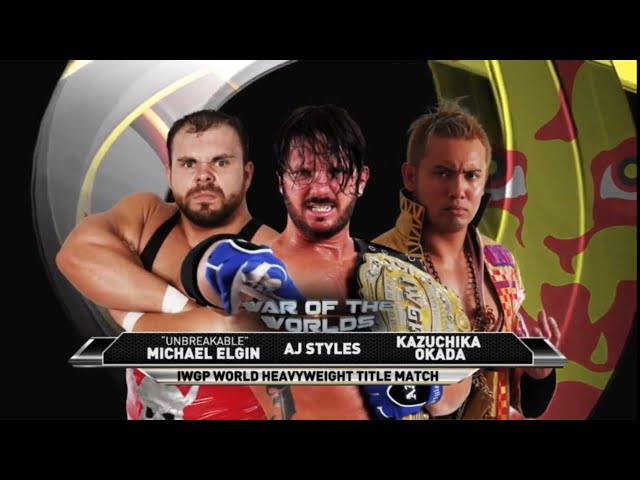
Michael Elgin had every reason to think that Kazuchika Okada would be waiting for him at War of the Worlds. He had beaten Kevin Steen at Supercard of Honor VIII to earn a shot at the IWGP Heavyweight Championship, which Okada held at the time, but AJ Styles complicated matters by beating Okada for the title at Wrestling Dontaku just two weeks before the show. That left Elgin with Styles instead, which wasn’t exactly unfamiliar territory either. The two had already wrestled to a time-limit draw earlier that year, and Elgin had beaten AJ in their rematch in April. Then Okada suddenly found himself without an opponent at War of the Worlds, and when he confronted Styles at the start of the show, Elgin came out and proposed the obvious solution himself: put all three of them in the same match. He called out ROH matchmaker Nigel McGuinness, who had the authority to change the match but still needed New Japan’s blessing since their world title was on the line. McGuinness checked with NJPW chairman Naoki Sugabayashi at ringside, got the approval, and then made sure all three wrestlers agreed. Styles reluctantly went along with it after talking things over with Bullet Club, and what had been Styles versus Elgin became a more complicated proposition with three men now involved. However, gold is gold, and fortune favors the bold, and all that. These three very capable men now have a title match.
There’s no real good guy to root for here. Ideologically, Styles, Okada and Elgin are three mercenaries chasing personal glory and fame. Styles wants to keep his place at the top, Okada wants his championship back, and Elgin wants to take it for himself, and in the words of Gambit, “Woo, I’m about to make a name for myself here!” There’s nothing particularly noble about these ambitions. But they are still human things to relate to. They’re in this for themselves, and whoever wins gets the gold and the satisfaction of being better than the other two. Which is perfectly fine. Three selfish men chasing the same prize is more than enough reason to have a fight. Plus the in-ring ability in this one is of such a level that you stop trying to look for some deeper emotional anchor other than greed and vanity because the action gets to you.
But before all that, I gotta get something off my chest.
I’d like to posit that a good triple threat match is one that produces two feelings: uncertainty and urgency. There is a feeling of uncertainty when anything can happen between the three combatants. They can form alliances, and these alliances can shift throughout the match depending on who has the momentum, or they can honorably duel amongst each other until only one man is left standing. A triple threat should always feel unpredictable, and all three contestants should remain consequential to the match. I think bad triple threat matchups are those where the story focuses on only two of the wrestlers while the other is just there as a third wheel to absorb random spots or consume dead space.
Urgency is very important to me unless the build-up for the match focuses on something more personal than winning, such as, say, vengeance or hatred. But for the most part, urgency is important in a triple threat because it conveys the necessity for each individual to want to win the match as quickly as possible. You’re going up against two other people; why would you want to prolong the contest any further? Two opponents means two unique ways of getting hurt. It also means two different ways of losing the match. Bad triple threats are ones where the wrestlers forget this internal logic and do things that are counterproductive to their own well-being, such as extending the match or stupidly exposing themselves to needless danger. At that point, it stops being a fight and it becomes obvious to the fans that they’re watching a show.

Of course, there are exceptions. Take the Shield triple threat at Battleground 2016. Ambrose and Rollins had enough personal history, especially with Seth’s betrayal, that you could understand why simply winning might not satisfy them. The same goes for Triple H and Shawn Michaels at Backlash 2004, whose hatred for each other could reasonably interfere with their pursuit of Chris Benoit’s championship. Sometimes a wrestler wants to make somebody suffer, even if doing so compromises his chances of winning. That sort of stupidity is perfectly understandable when the characters have given us a reason for it. But without that personal history, why the hell would you deliberately make an already dangerous fight any longer than necessary?
The funny thing is that Styles, Okada, and Elgin spend a good portion of this match doing something I just complained about. They keep breaking the triple threat down into singles matches, except here it feels deliberate because each pairing has a reason to exist. Okada wants Styles because Styles took his championship from him two weeks earlier. Elgin wants Okada because that was the champion standing at the end of the road when he first earned his title shot, but he has also already beaten Styles and has every reason to believe he can do it again. Styles is caught between both of them, although he is also the one man who doesn’t need to prove anything to either. Because he’s A-JAAY STYLES! And because he already has the belt. So the match keeps changing depending on which two men manage to get their hands on each other, and the third man isn’t disappearing because the match has forgotten about him. More often than not, he’s trying to get back in because somebody else is having the match he wants.
The opening minutes make all of this pretty easy to see. Okada immediately goes after Styles because, of course, that’s the man he came here to fight, but AJ quickly gets dumped outside and suddenly Elgin has exactly what he originally wanted: the Rainmaker, Kazuchika Okada standing across the ring from him. Styles doesn’t rush back in either. He hangs around outside and lets the two challengers have at it for a while, which makes perfect sense for the only man in this match who already has what everybody wants. Eventually Elgin gets Okada up for one of those absurd delayed vertical suplexes of his, and AJ sees his opportunity. He attacks Elgin’s supporting leg, and while Elgin stubbornly manages to finish the suplex anyway, Styles has already found a weakness to exploit and aggravate.
There’s something particularly fun about watching AJ Styles during this period because he already feels like a wrestler who has lived several different lives. The young freak athlete from TNA is still in there somewhere, and he can still spring off the ropes or twist himself through the air with the best of them, but by 2014 he doesn’t need to rely on any of that to convince you that he’s special. He still has a dangerous arsenal of course, age has not robbed him of his knack for pulling out random maneuvers. But now, he’s become a much more patient wrestler, and there’s a confidence to the way he carries himself here that I really enjoy. AJ can afford to stand outside and watch Okada and Elgin beat the shit out of each other because he understands that doing nothing can sometimes be the smartest thing you can do in a wrestling match. Then, when he finally does interfere, he doesn’t try to outmuscle Elgin or interrupt the suplex for the sake of getting himself back into the action. He kicks the leg holding all that weight up. It’s such a small thing, but I think that’s the beauty of AJ Styles at his best. You can spend all day talking about the spectacular things his body can do, but sometimes the thing I enjoy most is watching him use his mind.

That keen intellect is at work here with Elgin’s leg. Once AJ has smelled blood, he keeps returning to it with kicks and a shinbreaker, which creates the first real problem Elgin has to solve in the match. His entire game is built around being able to pick people up and throw them around, except now the base for all that strength is damaged. When Elgin tries to deadlift Styles into a superplex, the leg visibly gives him trouble and Okada immediately takes advantage by dropkicking him from behind. That leaves Elgin on the floor and, for the first time, Okada finally gets AJ to himself. The Rainmaker and his formidable quarry finally have a moment to themselves. But even then Okada takes a second to make sure Elgin isn’t coming back before he turns his attention to Styles. It’s a tiny gesture, but I love it. It reinforces how much of a threat an unchecked Elgin poses such that when he is isn’t active the match structure changes from one of outright survival to something more of a gamesmanship between Styles and Okada. Elgin’s momentary absences lets the match become Styles versus Okada deuce for a little while without either one, or the audience, forgetting about the two-hundred-and-fifty-pound man-mammoth lying outside the ring.
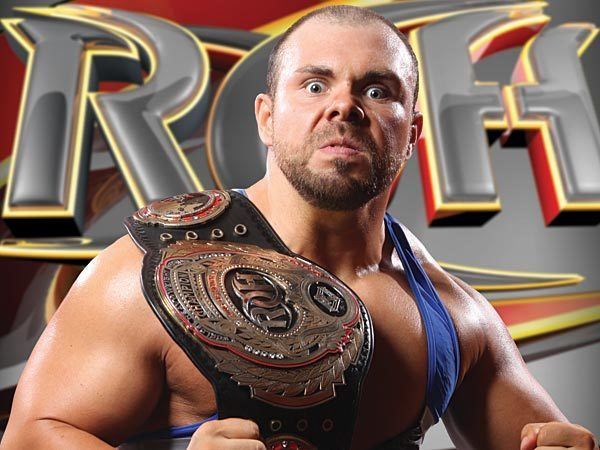
Speaking of which, the Donphan-looking fellow is the Unbreakable Michael Elgin. He’s 28 years old in this match and is one of Ring of Honor’s rising stars. He’s famous for incredible feats of strength, and he has that bullish, steam-engine bulk that pairs so well visually with the sleeker cruiserweight types of 2010s ROH.
Entering this match, he’s been very vocal in interviews about his desire to make headlines in the Japanese wrestling scene, so imagine his malicious delight when he sees two proverbial birds within a stone’s throw: the IWGP champion in one corner and New Japan’s biggest star in the other. By winning this match, he can be champion while proving his mettle in the most definitive way.
And almost as if to remind us of all that big boy bravado, Elgin comes flying back into the match with a shoulder tackle from the top rope. Whatever cute little contest Styles and Okada were having is over because the man-mammoth is back, and he doesn’t care that these two have unfinished business with each other. They’re both standing between him and something he’s wanted for years, so he starts throwing them around with the sort of casual strength that makes Michael Elgin such a compelling third man with his own kind of brutish charisma. At one point he catches both of them at the same time, planting one with a Samoan drop while sending the other flying with a fallaway slam. There’s no alliance to break apart and there’s no need for some clever way to insert Elgin into their rivalry. He’s simply too fucking large a tactical problem for them to ignore.
The problem is that Elgin’s body hasn’t forgotten Aj’s little liberties to it. All that throwing people around eventually catches up with him, and after another burst of power he comes down favoring the same leg Styles had been working on earlier. This is where the leg work starts earning its keep because it doesn’t prevent Elgin from doing Michael Elgin things, it just becomes more costly and taxing. He can still overpower either man and toss them around when he gets his hands on them, but every time he plants that bad leg there’s a chance the enormous engine underneath him sputters. AJ knows this, of course, but so does Okada, and the Rainmaker has been quietly benefiting from the damage without having to do much of the dirty work himself. That’s another thing I like about this match: if there’s a weakness to exploit, it’s open season for everyone to take advantage of. It really enhances the free-for-all atmosphere of a triple threat when one person can profit off the hard work of another.
But don’t let his smug and opportunistic mien fool you. Okada at this point was putting on a 2012 Kevin Durant kind of tear across New Japan. At the age of 26, he has already had two IWGP Heavyweight Championship reigns, was the youngest-ever winner of the G1 Climax, and has warred with Tanahashi for control of New Japan’s main-event scene.
His second reign alone lasted 391 days, with eight successful title defenses before Styles finally took the belt from him two weeks ago. That’s more than a year of Okada getting used to the idea that when the IWGP Heavyweight Championship is on the line, sooner or later the match ends on his terms. Then AJ Styles arrives and takes all that glory away from him. So there’s a little more behind Okada constantly trying to get AJ alone here than simple revenge. Styles has something that, until very recently, belonged to him, and every time Elgin barges back into their fight, Okada is being denied the chance to settle that score properly. It also explains why he never completely loses track of Elgin. He may want Styles, but he knows better than to pretend there isn’t another man in the match who can take screw him over.

The one thing Okada has going for him is his Rainmaker, a devastating ripcord lariat that has allowed Kazuchika to fly his banner over every arena in Japan. The Rainmaker is so protected that Okada’s foes know better than to test themselves against it. A typical Okada match sees the challenger constantly avoiding the setup for the Rainmaker. They know that if they get hit by it, there’s a good chance they’re looking up at the stadium’s ceiling. Okada’s nasty lariat is an obstacle that both Elgin and Styles need to be wary of for the entire match.
Back in the match, Elgin continues throwing his considerable weight around. He hurls Styles like a spear into Okada and follows that up by deadlifting AJ into a German suplex, but nobody stays in control for very long. Elgin tries to catch Okada with a running knee and gets countered with a reverse neck-breaker, only to recover and put the Rainmaker down himself. Styles gets dragged back into the fight, Elgin starts looking for the Elgin Bomb, and Okada is there to spoil that too. The exchanges are getting faster now, and control keeps passing between all three men because nobody is allowed enough time to settle into his own comfort zone to call the shots. Eventually Okada gets Elgin alone long enough to try the Tombstone, which turns out to be a mistake which Okada pays for.
There’s also a little problem developing with Elgin’s leg. He never really stops using it because realistically, He can’t. So much of his offense depends on planting his feet, carrying another man’s weight and driving through his legs that every big display of strength risks aggravating the damage AJ has already done. In his desperation, Elgin goes so far as to attempt a Codebreaker from the top rope on Styles, a move that, as commentary points out, he doesn’t normally use. The longer the match goes, the more Elgin effectively starts hurting himself by trying to keep up. You see it beautifully when Okada goes for a Tombstone and Elgin reverses it into one of his own. He plants Okada, tries to capitalize, and immediately reels away clutching the bad leg because he can’t bend the knee properly for the cover. Elgin has just won the exchange and still somehow comes out of it worse. It doesn’t help that in his frustration to fend off two enemies, Elgin sometimes resorts to dropkicks and knee strikes; those little things eat away at what’s left of his foundation.
AJ, naturally, notices. He goes straight back to the leg and traps Elgin in the Calf Killer (only called the Calf Crusher in WWE because, uh, killing is a bad word). It’s another example of why I enjoy Styles so much here. He doesn’t need to create another opening because Elgin has already created one for him with some ill-tempered decisions. AJ injured the leg earlier and then Elgin’s own offense keeps the wound open and fresh, then Okada rears his head to complicates things. Meanwhile, Styles is just perfectly happy to let both men do his work for him. It is the prevailing chemistry which the match builds towards. One can also interpret this as Styles using his experience and age as an advantage to set himself up as superior to his foes. He’s older than both men by almost a decade and has been through some tough battles. He’s applying everything he knows to win this match.

Okada is the one who finally breaks the Calf Killer, but Elgin is in no condition to thank him. He rolls toward the ropes clutching his leg while Okada plants Styles with an implant DDT and goes for the cover. AJ kicks out, although commentary points out something more interesting happening behind them: Elgin is in so much pain that he can’t even get up to break the pin instead relying on AJ’s own instincts of self-preservation. Sure enough, Okada goes back to work on Styles while Elgin can do little more than watch helplessly from the ropes. It’s a great sell from Elgin and a smart way for the match to extend the action without feeling illogical or forced. It also justifies a singles match up in the middle of a triple threat because the third man physically cannot take part in it.
Okada eventually starts setting AJ up for the Rainmaker, and that finally forces Elgin to move. Even then, he can only manage a backslide on Okada, which is funny and ironic for a man whose usual solution to problems is picking them up and throwing them around the ring. Again, much praise for the accumulative selling, Unbreakable Elg. Okada kicks out, but Elgin gradually composes himself enough to mount another offensive charge despite the pain. A few moments later, he’s somehow back on the second rope deadlifting Okada into a superplex. It’s an incredible display of strength from a man whose leg has spent the last several minutes sounding all the klaxons. But one can argue that it is desperation willing the body to overcome the visible toll the damage is taking on him. AJ immediately comes flying in with a 450 splash, and Elgin rolls out of the ring grimacing while Styles once again profits from somebody else’s labor. True to form for the mercenary leader of the Bullet Club.
With Elgin temporarily disposed of, Styles turns his attention toward picking apart the carcass of Okada, only to discover that the Rainmaker is still very much alive and hitting, in this case, with elbows to AJ’s face. Styles tries to put him away with the Styles Clash, but Okada escapes, and turns the exchange around to plant the champion with a Tombstone piledriver. I won’t say that this sequence sums up Okada’s whole contribution to the match but it’s a good indicator of how, at least in my opinion, he’s more of a tag or singles guy than a triple threat kind of performer because a lot of his best work is when he has tunnel vision for his opponent. You give him two targets and he really feels distracted in a performance sort of way. You can see it here and you can catch glimpses of it in his AEW triple threat matches although he’s much better now, he has a tendency to be lost in terms of pacing himself. Okada has always been a tad bit formulaic in how he builds his matches towards a Rainmaker finale so you watch him here you get the impression he’s biding his time by being economical up until the finishing stretch. Like his whole contribution here is that whenever he tries to set someone up for a Rainmaker, it creates this gravitational pull that sucks in the match. Nothing fatal about that, I just thought you should know, for interest’s sake.
The Tombstone finally gives Okada the opening he has been looking for, and he starts setting Styles up for the Rainmaker. Elgin, somehow still ticking, throws himself back into the fight before Okada can finish the job. He drives Okada into the turnbuckles with a buckle bomb and tries to keep going, but there’s only so much punishment a man can absorb before it affects his game and one can interpret that a weaker base for Elgin means that his entire arsenal has now diminshed in terms of efficacy. Okada survives the charge, and he gets Elgin where he wants him and finally lands the Rainmaker.
In a singles match, that should be it. Elgin has spent half the match destroying his own leg; he survived the Calf Killer, dragged himself back into the fight only to be now beheaded by one of the most devastating lari of the 2010s. Okada has done everything necessary to win the match. There’s just one problem: there are three men in this bad boy.

Styles comes flying back into the picture with a springboard forearm that sends Okada out of the ring, and suddenly AJ is standing over what’s left of Michael Elgin. It’s almost unfair how perfectly everything has fallen into place for him. Styles attacked Elgin’s leg in the opening minutes, watched Elgin aggravate the injury himself, let Okada contribute to the punishment and has now allowed the Rainmaker to do the hardest part of his job for him. AJ picks Elgin up, hits the Styles Clash and retains the IWGP Heavyweight Championship.
Although this match is filled with some good fun action, there’s a lot of thinking going on in the spaces between, which I like from a critical standpoint. The payoff with Elgin’s leg, for starters. It goes beyond Elgin simply being hampered and bogged down. He’s still threatening enough to preoccupy both Styles and Okada but loses just enough mobility to do the important part of finishing off either opponent, even when he chains together some good offense. Like, yes, he can still do his many power moves, but as the match progresses, he gets slower and more clunky because of the pain and damage. This affair with Elgin’s leg allows for Styles to have an identity on offense by giving him opportunistic windows to operate with. Working around a hobbled Elgin is one of the smarter plotlines in the ring to keep the others from doing too much predictable action. For example, it gives Okada another opponent to worry about so that he doesn’t keep honing in on Styles. Because Elgin is more vulnerable, he becomes a viable, if not easier, option to pin as opposed to Styles. It creates a dynamic where the three guys are doing something, but they’re not doing too much of it, and it feels haphazard in the most believable of ways.
The strength and timelessness of this match is that it stays true to maintaining that air of uncertainty and urgency I harped on about earlier. From start to finish, the wrestlers effectively communicate how winning is the most urgent priority for them. Every move they do and every strategy they employ is devoted to the singular purpose of winning. And you can see it in how realistically flawed their offensive sequences are. They never build momentum toward just one opponent; whenever they string together a chain of great attacks, they quickly divert their attention to the other wrestler and work on him as well. It’s like one of those burger flippers who keeps alternating between two patties, one eye on one guy and the other eye on another. It makes so much sense, at least to me. They’re fighting two opponents, and human nature is normally predisposed to multitasking when both tasks are due. It never once feels like they’re doing things to please the audience or because they have a checklist of things to do. They gave this Triple Threat the sort of respect it deserves.
The match also never feels like it’s in the bag for any particular wrestler. I posited earlier that a good Triple Threat should feel uncertain, and this match shows that by creating a very balanced relationship between the three wrestlers. Elgin is obscenely strong, with his deadlift suplexes, bombs, and tosses, but he hurts his leg early on and that costs him dearly, so much so that he cannot even follow through with the pin in one instance. His leg becomes the most glaring issue that humanizes him to the audience. Kazuchika Okada looks lost by design because this appears to be his first Triple Threat ever (I could be wrong, but I did check), so he’s trying to adjust his tactics to the chaos of having two opponents coming at him at the same time. And unlike a tag match, he has no backup here and no moment to rest. He’s made his bones in Japan as a singles wrestler, so here he’s faced with issues he has no experience with. AJ Styles is the champion; he’s not just here to win, he’s also here to retain the belt. That burden leaves him with no choice but to pick his battles and snipe because he’s the most obvious target here. The match captures this very complicated dynamic as well as the strengths and weaknesses of all three men.

This match deserves so much love because it’s so intelligently made, and that might be its problem. A lot of thought was put into its soul, so the shell feels like it could use some more paint. By paint, maybe just little bit more of that sports entertainment acting or crowd control just to break the monotony of the three guys being really focused on what they do. Just a tiny bit for the ‘it’s cinema wrestling’ crowd. It doesn’t have that flashiness that most Triple Threats tend to have; everything feels so discordant, like the aftermath of a cavalry charge where everyone is just slugging it out in the mud and all their shiny armor is caked in dirt. It doesn’t have that sort of neediness to overexplain what’s at stake. That’s fine by me; they’re all fighting for gold, what other drama would you need? I can appreciate the restraint, but I guess some people like that neediness. Whether it’s blood, more charisma, some overwrought acting, or drama between the three, some people need their strings tugged in order to be moved. But for the wrestling fans with eyes to see and ears to hear and a heart to feel, this is a classic. This is something to be loved.
★★★★½ — 4.50 | MOTY Contender


Leave a Reply