“It’s supposed to be hard. If it wasn’t hard, everyone would do it. The hard is what makes it great.”
— Jimmy Dugan, A League of Their Own (1992)
Years after their much-celebrated Women’s Revolution, WWE’s collection of supposedly all-time classic women’s matches still leaves much to be desired. Honestly, once you step outside the Bayley–Sasha orbit, everything else becomes a matter of debate or preference.
A decade on from 2015, the catalogue remains very Horsewomen-centric, with the occasional bit of Asuka brilliance. They’ve always had a strong roster, but an older Vince who was less hip to the times and still held the book dammed up what should have been a river of quality performances up and down the card. Considering WWE was still the only game in town and had the black-and-gold program churning out capable workers, it feels like a travesty looking back at how they ran their women’s division during the late-Vince era.

Ultron once had a musing that feels apt here: “The most versatile substance on the planet, and they used it to make a Frisbee.” WWE provided plenty of examples to buttress his point: Nia Jax as the insecure fat best friend to Alexa Bliss; Bayley being too pure to swing a kendo stick; Sasha and Bayley being sent to friendship counseling; Ruby Riott destroying Jim Neidhart’s sunglasses; Mandy Rose trying to cuck Naomi in a hotel room; and Ric Flair’s affair with Lacey Evans. Oh, and a special shout-out to Timeless Toni Storm for taking a cream pie to the face.
Don’t get me wrong, I grew up in the Attitude Era, and I can digest a good plate of sports entertainment, but it rubs me the wrong way when the stories and angles are so far beneath the talent performing them. For all WWE’s talk about a Women’s Revolution, its presentation kept retreating into the worst caricatures and stereotypes of women long after every indication told them it was no longer 2003. They’ve got daughters and wives, right? That’s a damn focus group discussion right there.

All of which is why this Triple Threat feels like such a necessary addition to WWE’s women’s canon, and why it can comfortably be counted among the greatest matches the division has ever produced. It has a build that doesn’t denigrate any of the three women or insult the intelligence of a fan in 2025, and the match has a tight, clean finish that relies on the innate talent of its workers instead of the usual hokey tricks WWE employs—no stupid interference and no convoluted referee bump.
Iyo Sky entered WrestleMania 41 as Women’s World Champion after dethroning Rhea Ripley on Raw in March. Bianca Belair had already earned her title shot by winning the Elimination Chamber, while Ripley refused to accept that one loss had removed her from the match. Rhea’s championship rematch, with Bianca serving as special guest referee, collapsed into a double disqualification after both wrestlers accidentally struck Belair, leading Adam Pearce to add Ripley to WrestleMania. All three therefore arrived with very logical motivations: Iyo is the champion, so she needs to protect her legitimacy; Bianca has a guaranteed title shot; and Rhea feels aggrieved by the law. It’s so simple, yet it cuts to the heart of human nature: ambition. They all want to be great.
The match opens with the emotional powder keg immediately going off. Bianca and Rhea get in each other’s faces and try to push Iyo aside. This pushing aside works into their initial strikes and jostling for control. Rhea and Bianca never get as much time as they want to lock horns because Iyo always gets involved, like when Bianca works Rhea in the corner and Iyo interrupts, culminating in Iyo hitting both of them with a double blockbuster. It’s a very catchy way to seamlessly connect the offense of all three while avoiding those Charlie Chaplin sequences where it’s three wrestlers forming a circle throwing punches at each other with rabid contortions.

There’s one particular bit here that catches my attention because it adds to my argument: Bianca throws Iyo out onto the apron, grabs her head and bashes it into the turnbuckle. Bianca then gets hit with a boot from Rhea, and she tumbles outside the ring. Rhea hits Bianca again, this time with a cannonball from the apron, but as Rhea gathers Bianca for presumably more offense, Iyo recovers from the turnbuckle spot and hits Rhea with a middle-rope moonsault. It’s a clean, logically executed sequence because the individual parts prevent the coordination from being too apparent. Iyo gets taken out momentarily, and it buys Rhea enough time to use a running boot and a cannonball to achieve two things: push Bianca outside the ring and leave herself within range of Iyo’s aerial maneuver. It eliminates those unwieldy pauses that turn a Triple Threat into a one-on-one, and it has enough internal logic that the average fan of a reasonable mind will accept it as plausible. The case would have been much different if Bianca had simply hit Iyo with a punch and Iyo had sold it for the same amount of time. Now, that screams coordination. That shit happens too, by the way.
That chemistry becomes more impressive once you consider where each of them came from and how they got to this big moment. One of the things that impresses me about modern wrestling promotions is their knack for retooling rosters around potential stars and capable veteran journeymen. It reminds me of the NBA, minus all that other nonsense like signing over-the-hill stars to big contracts even when they can’t deliver anymore. Oh, wait. Never mind.
Iyo Sky had already been wrestling for more than a decade when WWE signed her in 2018, with multiple Stardom championships and a reputation as one of Japan’s best wrestlers, so NXT received something close to a finished product. She had held Stardom’s top championship twice, and Tokyo Sports had named her Japan’s leading women’s wrestler in three consecutive years. There was already a considerable body of work to go back to if someone wanted to understand the fuss. Her introduction to WWE was happening well into a full-bodied resume.
Still wrestling as Io Shirai, she became NXT Women’s Champion in 2020 by beating Charlotte Flair and Rhea Ripley in a triple threat. Her main-roster arrival came two years later alongside Bayley and Dakota Kai in Damage CTRL, which initially placed her within a group built around a much more familiar WWE personality. But Backlash in Puerto Rico in 2023 offered a useful indication of how readily she could command an audience herself. Against Bianca Belair, Iyo had the crowd firmly behind her despite being the heel. I think that matters when describing her rise. People wanted her to win, and you can argue she was or is the biggest WWE joshi star since Asuka and in a post-Vince world, at that.
Winning Money in the Bank and cashing in on Bianca at SummerSlam later that year made her WWE Women’s Champion. By March 2025, she had beaten Rhea for the Women’s World Championship and secured her place at WrestleMania again. There’s something satisfying about following that career from its Japanese beginnings and seeing how many different audiences eventually found their way to her. No surprise that Triple H considers her the Ace of his women’s division.

Rhea Ripley came into WWE at twenty, much rawer and still figuring out what made her distinct. She has since described how frightened she was of getting things wrong, even using her long blonde hair to hide behind. By the second Mae Young Classic, she’d cut it and turned up in new gear without telling anyone. There’s something very youthful and 2020s about trying to figure out who you are, then deciding, fuck it, we’re gonna go the Goth baddie route.
NXT UK and NXT gave that presence somewhere to develop. Becoming the inaugural UK champion established her, but beating Shayna Baszler in 2019 offered a particularly clear picture of what she could mean to an audience. The Full Sail crowd joined the wrestlers in the ring and lifted her onto their shoulders. That’s a considerable distance to travel from worrying about whether she belonged there.
Judgment Day gave her room to enjoy her growing power over the WWE fanbase. Her relationship with Dominik made for some good television. She could get involved in the men’s business and even become someone they had to answer to. I think that mattered enormously to her rise: there were more reasons to watch her every week, and more chances for her personality to come through. By the time she beat Charlotte at WrestleMania 39, you could say she was already getting to be as big as Becky Lynch. Let me tell you, that’s saying something given how big Becky’s star had become.

Bianca Belair had the strangest route of them all. She arrived at the Performance Center in 2016 from track and field and CrossFit (courtesy of Mark Henry) with almost no wrestling experience. She developed at a ridiculous speed and won the 2021 Royal Rumble in dominant fashion. She then made history when she main-evented WrestleMania 37 against Sasha Banks, making it the first WrestleMania main event featuring two African American women.
What impresses me about Bianca is how quickly she became convincing as the person a major match could revolve around. Those physical gifts gave her an enormous head start, and she learned how to let an audience get invested in the woman who possessed them. At the beginning of the Sasha match, she was visibly overcome with emotion. I think that openness is an important part of her appeal. Being the EST carries a fairly ridiculous promise, especially in a profession where everyone is supposed to claim they’re the best, and Bianca could make the claim seem reasonable while still showing how much she had riding on proving it. There’s room for some insecurity in that confidence, which gives an opponent something to get at. She could already do things that most wrestlers couldn’t, and within a few years she had become someone whose success was palpable. That’s a considerable amount of the profession to pick up so quickly.

By 2025, those three paths had finally converged in the same ring, each woman carrying a distinct wrestling identity and all three at the peak of their powers. It’s such a full-circle moment for a division that once built an angle around AJ Lee kissing her way through the roster and paraded the Bella Twins like they were the second coming of the Road Warriors.
The match encounters some of the usual potholes as it attempts to flesh out those different wrestling backgrounds for the audience. There are some isolated one-on-one matchups, but the match structure maintains the discipline to regulate these instances. They’re more like footnote sequences used to differentiate the three women. Bianca gets enough room to shine, conveying that she’s the athletic bridge between her two opponents. She has the speed and fleetness of foot to match Iyo, but she also possesses enough raw power to best Rhea at her own game. The language is plain for all to see: a flurry of consecutive suplexes and that Tower of Doom spot establish her as the undisputed offensive threat here.
Rhea is closer to the traditional WWE powerhouse here. Although she has occasional explosive bursts, she is the slowest of the three, so the match uses her in brief, forceful stretches and lets her power supply the weight that Bianca and Iyo generate through movement. She’s presented as the craftier of the three, hovering around Bianca and Iyo and using her strength to pick apart whatever is left behind. The Razor’s Edge javelin throw and Prism Trap spots tell the audience in so few words that no matter what Bianca and Iyo can do, Rhea has enough skill and power to keep up. It’s classic WWE match construction of using less is more to protect a limited worker from being overexposed.
Iyo is lightning uncaged here. She’s fucking people up with Bullet Train Attacks, missile dropkicks and her acrobatic reversals. She’s moving dynamically, and she has to because she’s presented as being outmatched by the other two physically whenever they get their hands on her. She’s by far the best seller of the trio, so it’s no surprise that she’s part of almost every major offensive sequence and eats most of the bombs too. She does that fish-flopping sell with her legs that visually pairs well with clean, hard-hitting powerhouses like Bianca and Rhea.
The year before WrestleMania saw all three women scattered across the division. Iyo’s transformation from heel to face happened gradually, as Damage CTRL began fighting the Pure Fusion Collective and Iyo eventually stood beside Rhea and Bianca in WarGames. There was no grand moral conversion there. She was simply getting over with the fans, and running her as a heel limited her usage within the logic of the WWE system, so they turned her face. Entering Mania, she had already garnered a reputation as the best worker in WWE’s women’s division.
Rhea spent the better part of that same year trapped in the Liv Morgan feud, a revenge angle that started with her injury and eventually swallowed Dominik Mysterio, the Judgment Day and Raw’s Championship belt. That feud remade Liv into a top-tier player, and it solidified Rhea’s star power. It was also compelling enough that it endured for nearly a year and distracted fans from the fact that neither Rhea nor Liv was a fighting champion. Rhea finally regained the belt on Raw’s Netflix premiere, only for Iyo to take it from her two months later.
Bianca, meanwhile, had been diverted into the tag division with Jade Cargill. They won the titles twice, and the partnership consumed most of the time Bianca might otherwise have spent near the singles championship. It was a decent gesture to get Cargill over and at the same time babysit her and acclimate her to that very nebulous thing called the WWE style. It was quite a controversy at the time. People were not used to seeing the EST so distant from the big belt main event orbit. I distinctly remember some Triple K essays going around. Winning the Elimination Chamber finally put her back where she belonged.

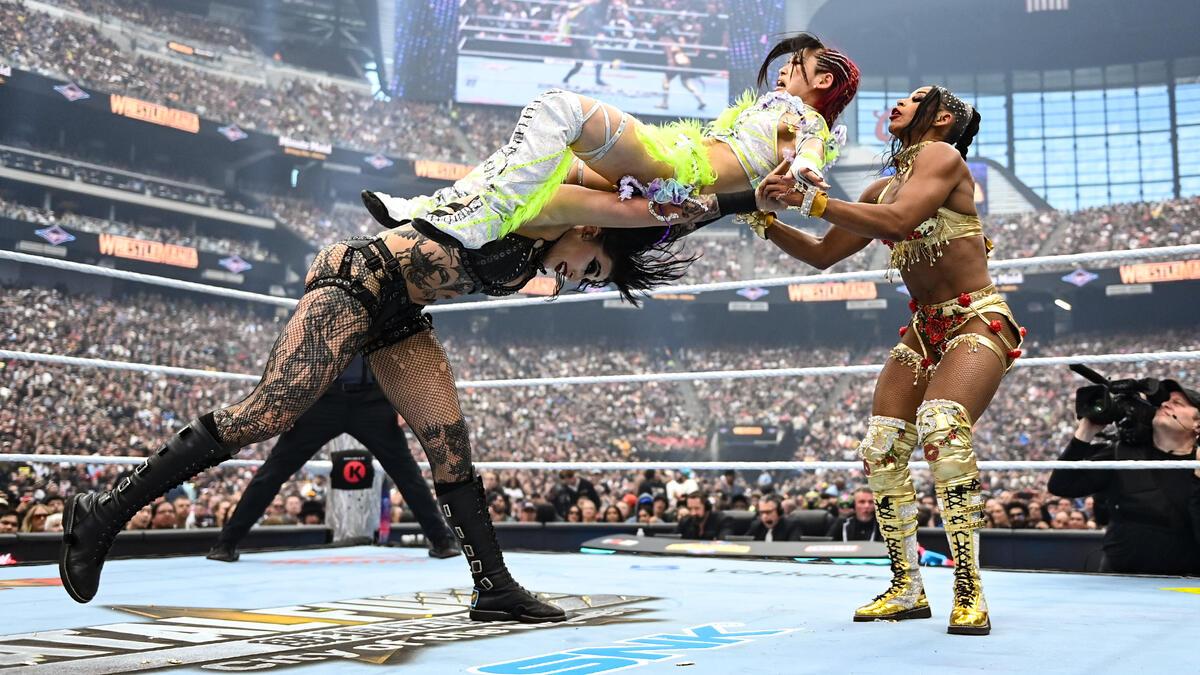
All these motivations coalesce into the finishing stretch, and wow, is it a fucking finish. Michael Cole said it best: “What action! 450s and Riptides, and in the end KOD!” The climax becomes a stream-of-bombciousness, with one pinfall broken up after another until Bianca Belair is left enraged and indignant. Belair and Rhea trade some strong elbows and punches. They struggle on the top turnbuckle, but a Mami-sized headbutt sends Bianca crashing outside the ring.
Iyo takes Bianca’s place, and she and Rhea fight on the top turnbuckle. Iyo attempts a poisonrana, but Rhea catches her and folds her into an Alabama Slam, driving her face-first into the top of the ring post. Bianca returns and hoists Rhea up for the KOD, but Rhea lands on her feet. They trade another flurry of shots before Rhea hooks the pumphandle for the Riptide. Bianca floats over, whips her across the stomach with her braid for that trademark Bianca hair spot and finally plants her with the KOD. She has Rhea beaten, but Iyo is already above them. Before the referee can count three, Iyo comes down with Over the Moonsault across both women and pins Bianca to retain her championship.
Uncertainty and consistency of character are the most obvious virtues of this match, and these are also virtues I look for in Triple Threats. Their positioning allows that uncertainty to flourish because all three women are almost always within striking distance of one another, and whether you are watching on television or sitting inside the stadium like little old fortunate me, you can understand where everyone is and what danger she potentially presents. Everyone is just one fucking roll away from breaking a pin or kicking someone in the face, so the action feels tight and compressed. You never get that sort of feeling that the combatants need to cover ground just to close the gap.

Some people might find the finish too “modern,” which is a polite way of saying that they didn’t like the extensive action and bombs. True, it does feel like someone pressed the Extra button, and these women suddenly went apeshit in terms of the pace and cadence. But I will argue that everything they did is still in line with the character beats they established prior to this match and during it. And it really shows urgency because these three women are motivated by personal grievances surrounding what they feel they are entitled to. Despite those grievances, their actions show that they are all trying to win this match as intelligently as possible without deviating from what makes each of them unique in this fight. Iyo’s offense, for example, is opportunistic, which represents how she’s been relegated to the periphery of Rhea and Bianca’s feud. She is so often the afterthought that she ends up being decisive. Bianca earned the most traditional path into the title match, so she wrestles most directly. She overpowers both opponents and searches for the KOD because that is how she has always been presented. Rhea’s position is complicated. She had stood beside Iyo at WarGames, but she wants to be champion again, and her right to be in this match is the least legitimate because she is using a technicality to justify her inclusion. That sort of greyness reflects in how she wrestles here, hovering around the exchanges and picking her windows to strike. So, in a way, if Bianca is the athletic bridge between Rhea and Iyo, then Rhea is sort of the psychological bridge between them. She’s a conventional powerhouse forced to use cunning because Bianca surpasses her athletically while Iyo possesses the greater technical skill. It’s also important to note that this is Rhea’s first Mania match against both Bianca and Iyo, and probably their first major encounter outside of Rumbles tag matches and WarGames. It may be me reading too much into it, but that sort of novel experience forces one to rely on instincts and experience, and who are the three women when pushed to the wall? Iyo has always been an opportunist who tries to capitalize on the moment, look at her character work in NXT and even her betrayal of Bayley. Rhea is fresh off her stint with the Judgment Day, where she served as its strategist and cunning schemer, and that sort of thing never leaves you. Bianca is the most straightforward one who uses her athletic ability to solve her problems. It’s a very nice full-circle moment to show us that these women who tried so hard to reinvent themselves end up falling into the most enduring versions of their own myths when push comes to shove.
It’s a great reminder of life as well: we are who we are in the toughest of times, even when we try to be something else.

The way mainstream American wrestling handles women’s identities has always been problematic because so much of their presentation has been bogged down by the idea that they must be objects of desire for the male gaze. How they looked was often treated as being as important as how they wrestled. And it’s not just WWE. WCW, TNA, smaller American outfits, and even the older territory promotions all had angles that smacked of misogyny and lewd sexism. I won’t lie, it was great when I was a teenager with raging hormones, but looking at it now, it makes me cringe at how excessive and juvenile the obscenity became. That is part of why this match stands out as a classic: it emphasizes good fucking wrestling, anchored by women with ambitions of their own rather than convoluted motivations that turn out to be little more than weird fetishes and cuck fantasies.

Beyond everything they bring to bear in the ring, they carry with them the renewed promise of a serious WWE women’s division that tries to go beyond those old tropes, a promise first made by the Four Horsewomen but squandered over the years through bad creative choices. Heck, If I’m being fair, even the Rhea-Liv-Dom love triangle seemed to be a throwback to that sort of women-need-men storyline. Or it just have been commentary on how some people just have bad taste in romantic partners, lol.
There is something ironic about this match opening Night Two of a WrestleMania whose main event revolved around the fading ambitions of a retiring John Cena, an old man corrupting himself in pursuit of one last piece of historical validation (wasn’t that good of a heel run anyway). And with how the Punk–Roman–Rollins match closed Night One, you could argue Mania 41 was dominated by male regret and unresolved resentment, with vulnerable, hurt men seeing ghosts everywhere and masking their pain and fear with lust for power.
That same impulse has shaped some of the defining wrestling stories of this half-decade: WWE’s rise, fall and return of the Tribal Chief, and Moxley’s obsession with imposing his vision on AEW. Both carry an NWO-style fixation on a madman trying to consolidate control over his world. The Hollywood Ending was a strong respite from the Death Riders, and this Triple Threat was probably the best match of the whole Mania. In a half-decade obsessed with men trying to run their worlds, these three women stood out by wrestling the only fucking five-star match of both nights and reminding people that women can wrestle too. If only for a moment.
Although so many things in the world remained broken and ugly in 2025, three women fighting over a belt and driven by a stubborn need to be the best turned out to have the best match of the whole weekend. With everything else in the 2020s going to shit mostly because angry old men with hangups and/or deviant fetishes wield absolute control over our welfare and lives, watching these three give a damn about being great at what they do felt like a small bit of sanity.

★★★★★ — 5.00: Generational Classic


Leave a Reply