Film and literature have canonical works that can survive changes in taste. For example, you may not like The Godfather, but its reputation is so established that the onus falls on you to argue against it. The same logic applies to literature: yeah, you can rip apart Pride and Prejudice, but again, it’s an uphill debate. To an extent, sports follow this same train of thought. People can argue that Jerry West was just a plumber and shouldn’t be a Hall of Famer, but they have to start from the fact that he is one. In wrestling, fans can’t even agree on whether a wrestler was any good, let alone whether that wrestler was legendary. We don’t have that kind of uniform language.
The problem with wrestling and wrestling fans is that everyone has their own version of what is and isn’t. The fact that you’ve got people who think the WWF invented wrestling and others who think it died with the territories should tell you how divergent this shit can get. Don’t even get me started on what non-American wrestling traditions believe about the sport. Wrestling is so subjective and means so many different things to so many people that, at some point, we’ll have fans arguing that Jey Uso was a bigger babyface than Stone Cold Steve Austin. It’s a very volatile world, driven more by emotion, and that’s why we have so many “what’s water for you is oil for me” conversations.
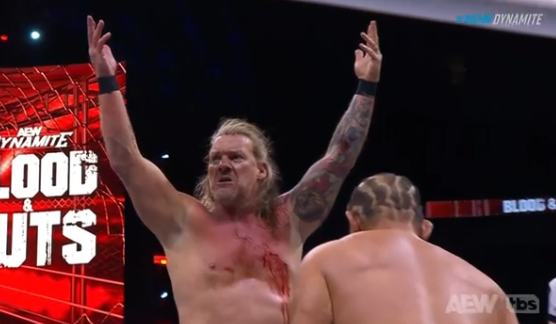
This FTW Championship match from the 2024 Blood & Guts episode is definitely a tall glass of black goo I could never get into. There are many ingredients here that are good enough that I can see people greatly disagreeing with me. You have a recognizable story of two aged vets, Chris Jericho and Minoru Suzuki, trying to test each other’s mettle after numerous failed attempts by Jericho to recruit Suzuki. Then you have that idea being explored through a lengthy strike exchange that also draws material from Suzuki’s roots. It’s all standard stuff that can work because of the players involved, but it never hits it for me for a slew of reasons.
First, I get that Jericho’s playing the guy who bit off more than he could chew when he stepped into the ring with a professional wrestler with an MMA background, all because he wanted his dream match. He aggravates that situation by foregoing tactics and trading chops to showcase that they’re “equals.” But man, they stretched that too much, and not in a Kobashi–Sasaki way, where the extended sequence raises the stakes for the later part of the match. They overindulged in it here, and just like any other time in wrestling where strike exchanges happen, I ask myself whether it’s a performative spot that’s just in the match for the sake of having it, or whether the exchange is trying to lead me somewhere. I say it’s the former.
There’s an argument to be made against me that it’s the latter. The exchange establishes Suzuki’s menacing personality. He’s not just some solemn master of shoot-style combat; he also takes sadistic relish in welcoming pain and dishing it out. As they get deeper into it, Jericho starts to realize that he can’t keep chopping because the most Suzuki gives him is a giggle. So Jericho has to decide if he’s going to win this match on Suzuki’s terms or on his own.
It’s a great idea, sure, but my argument as to why it’s performative is that the match could have achieved the same narrative effect in less time. Why? Because it feels like the match is operating on a flawed premise: that repetition is the best way to convey cumulative physical damage to a wrestler’s body. The chop exchange is purposely elongated to show Jericho’s foolhardy honor-war of attrition backfiring. I’ll argue that you can mitigate repetition as long as you replace it with intensity. Instead of a hundred chops, you can have fifty hard-hitting ones that convey the same devastation to Jericho’s chest. And here’s the thing: you already have Minoru Suzuki. If there’s anyone whose presence and reputation can convince the audience that fifty means more than a hundred, it’s him. So the tools are there to do it logically but for me it just looks like they wanted the long sequence because it probably looked cooler.
Which leads me to my second issue: the structure of this match. It’s not just that the strike exchange took too long; when the conflict leaves that idea behind, they kind of rush the next parts for me. A big chunk of time is spent focusing on Jericho’s chest getting gabagooled, leaving little time for the emotional and physical consequences of that to play out. How does losing the early game in bloody fashion influence Jericho’s adjustments? What does Suzuki do next after seeing that his quarry isn’t made of sterner stuff? What are the dynamics between both men now that one of them has psychological momentum against the other?
Instead of exploring those nuances, we breeze through them, starting with Suzuki targeting Jericho’s battered hand. That injury could have been a through-line: Suzuki tries to crush Jericho’s hand with steel chairs, then tries to break his fingers in the ring. It’s an evolution of the idea that Jericho may have worn out his hands during their early strike exchange, but the match’s sudden brisk pacing makes it a facile concept. If you’re going to put the audience through an almost seven-minute chop-a-thon, you need to devote that same diligence to showing its consequences. Otherwise, people just watched Jericho shriek and bleed for jackshit.
Finally, Jericho’s selling and internal logic leave much to be desired here. He doesn’t sell his crunched-up hand despite the emphasis given to it. I wasn’t convinced that he tried to protect it or made defensive adjustments to keep Suzuki away from it. The damage should also show up in how tentative or difficult it is for him to grip or support himself, and that injury loses weight when he sets up the Walls of Jericho without seeming to work around it.
I also think the transition from standing his ground against Suzuki to being opportunistic is abrupt. I would have preferred a slower, more measured pace that let us appreciate each moment of Jericho giving in to desperation and taking shortcuts. The low blow is there, but the match doesn’t give that shift enough room to land. It would have been nice to see how, in the face of danger and incredible violence, survival takes precedence over pride. This started out as Jericho’s dream match; Suzuki wanted to fight him, not join him. I wanted the match to make me wonder if Jericho still has that enthusiasm after everything that’s transpired.
Water or oil, oil or water. Wrestling is funny like that: I can write this, you can read it and decide I’m onto something, or think I’m a dumbass. The crowd couldn’t agree either. Some people were loving the match; others were yelling “Please retire” at Jericho. You might see an artist trying to capture new heights with his dream match while I see Tugg Speedman chasing Oscar glory. Learning Tree Jericho really was a goated run.
Match Rating: 2.75 — They Almost Had It


Leave a Reply