Shun Skywalker can go about things on his own so it’s such a shame to see him join House of Torture and inherit the same potential problems that plagued most HOT members. The House isn’t a bad idea in itself, but it has gotten some stench and backlash in the last couple of years that I wonder if Shun really needs to be a part of that group.
That presents a small problem for his first major singles match in the promotion. Shun Skywalker challenging Konosuke Takeshita for the NJPW World Television Championship should introduce New Japan audiences to what makes him must-see TV. Instead, the match gradually becomes another reminder that House of Torture has been stinking up the joint for quite some time now.
The match is built on a great contrast of abilities. Takeshita is the more imposing athlete. He has built his résumé around explosive acceleration and the ability to break through defenses with a kind of staggering force that’s delivered in a skill-heavy payload. I’m talking about forearms and well-timed big boots as well as his formidable arsenal of suplexes. Shun does not possess the stopping power to dominate him consistently, so his best game plan is to prevent Takeshita from consolidating enough momentum to become unmanageable. He begins with a quick pin and immediately looks for ways to interrupt the champion before he can establish his footing.
On the floor, Shun attempts to whip Takeshita into the barricade, but Takeshita reverses it and sends him crashing instead. The champion returns to the ring and tries to pull him back inside, only for Shun to snap his arm against the ropes. Shun then rushes Takeshita in the corner but receives an elbow for his troubles. Takeshita repeatedly beats Shun to the next position because Takeshita is faster and longer. Shun, to his credit, is a very canny fighter and manages to attack from compromised positions.
The clearest example is when Takeshita attempts a top-rope senton and Shun raises his knees. Shun later teases a standing moonsault, and Takeshita raises his own knees in anticipation. Shun fakes him out and quickly flows into a Boston crab. I don’t know whether I simply haven’t watched enough wrestling, but I found that shit beautiful. Feints and fake-outs are great offensive gems in wrestling, and I’m always caught off guard when I see one.
His cunning becomes more explicit once both men return to their feet. Shun mockingly slaps Takeshita around, knowing that the disrespect will provoke him. Takeshita loses his temper and tries to strike back, but Shun is already waiting with an eye gouge. The slaps were bait, and Takeshita’s anger makes his response predictable and ultimately exploitable.
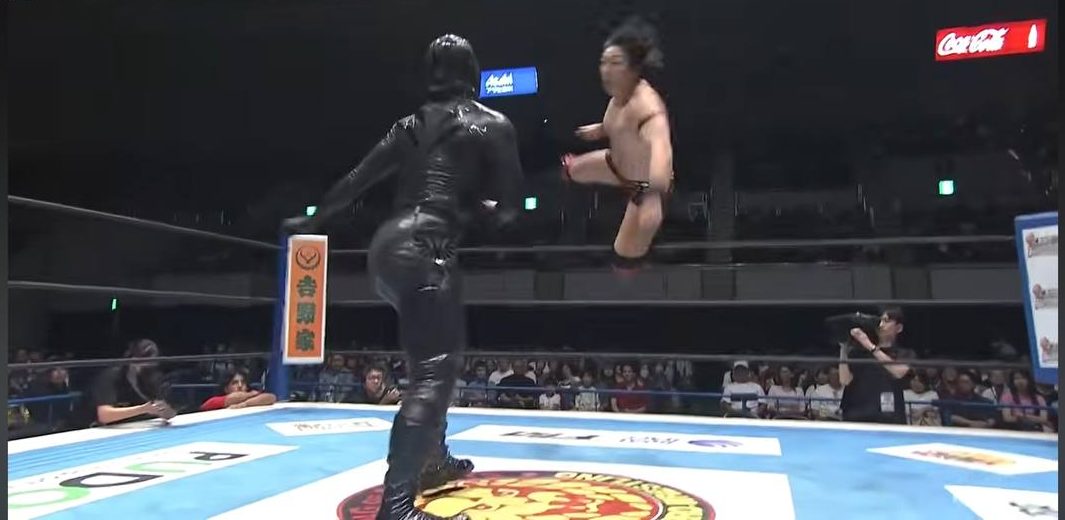
Shun cannot manipulate every exchange, however. When both men run the ropes and joust directly, Takeshita prevails with a flying lariat that sends Shun rolling outside. Shout-out to the cameraman who shot that sequence. You can see Takeshita twirl through the air. Takeshita then hunts him down with a tope con hilo, refusing to grant him any space for recovery. Once the champion begins moving freely, Shun cannot match him through force or acceleration. Back inside, Takeshita rushes him in the corner, only for Shun to answer with a big boot that visibly damages the champion’s eye. I like the cadence here. It doesn’t fully rely on manic bursts of energy, and both wrestlers know when to slow it down enough that the match does not feel like it is always ramping up needlessly.
Takeshita has to abandon any pretence of momentum to tend to his eye. Shun responds with mad laughter and a few opportunistic strikes, but an irate Takeshita fires back with a volley of forearms, and Shun sells them like he’s getting hit with a hammer. Shun stops his next rope run with another big boot and attempts a release German suplex, only for Takeshita to land on his feet. They run the ropes and joust once again, and Takeshita once again wins the exchange.
There’s something interesting I noticed in this match as far as ring positioning goes. Whenever they joust with each other in the open terrain of the ring, Takeshita easily wins most of the time. It’s like a Byzantine kataphract charging directly into a lighter horse archer: once all that armour collides, the smaller rider gets run over. Shun fares better near the corners, where he can see Takeshita coming at him and make the proper anticipations. So Shun’s best chance of winning in this match is to avoid direct line duels with Takeshita and instead rely on targeting his eye or trapping him in corners. Once Takeshita can accelerate or get enough balance to swivel for his devastating forearms, Shun usually loses.
When both men retreat into opposite corners and prepare for yet another head-on collision, Shun finally manages to flip the switch and catch Takeshita with a Claymore-style running dropkick—he gets a pretty lift on it too. Unlike their earlier rope-running collisions, Takeshita does not have repeated rebounds to build speed, and his line of attack is completely telegraphed. That makes it easier for Shun to intercept him. Takeshita kicks out and immediately tries returning to his favoured forearm offence because every time he does, the devastation to Shun is quite visible, but this time Shun intercepts it and parlays it into a spinning uranage. Shun, salivating over the idea of his coronation, hypes himself up for the finish and charges, only to run directly into a Blue Thunder Bomb. It’s a neatly done rise-and-fall-of-Rome bit that conveys how, for all of Shun’s success, Takeshita is still so plainly superior that Shun cannot take his boot off the champion’s neck for even a moment.
These are still intelligent counters, but the match begins expressing them through that familiar rhythm of bomb, counter and larger bomb. The underlying logic becomes harder to distinguish from your usual 2026 house-style escalation. Shun continues anticipating Takeshita and catching him before he can build speed, although the delivery has become increasingly familiar. Familiar isn’t bad, but I would have preferred the match to take a more psychological approach instead of going action-heavy for the climax.
The escalation makes sense under a fifteen-minute limit, but it feels like a cop-out and simply leaves the match less distinctive. Earlier, Shun’s intelligence was legible in every decision. By the end, the larger attacks begin crowding those details out. It also erases some of the impact of Takeshita’s offense because the early bits established that Takeshita is too great of an offensive problem to solve conventionally. Shun going heavy with the artillery doesn’t seem like the logical solution against an opponent with superior firepower.
The Blue Thunder Bomb leaves Takeshita too exhausted to cover immediately. That delay creates a tangible consequence because it gives Shun enough time to kick out. Takeshita nevertheless believes he has regained control and prepares to finish the match.
That is when House of Torture makes its presence known. A referee distraction allows Shun to blind Takeshita with powder before dropping him with the Blaster, a sit-out butterfly slam, and a standing moonsault double-knee drop. Takeshita survives all of that. More ringside vermin arrive to distract the referee again, but the champion sends Shun crashing into Dick Togo before hitting a poison rana and the Power Drive Knee for another nearfall.
The interference does not hand Shun the pin. Takeshita survives the damage, overcomes the second distraction and nearly wins afterward. Shun ultimately creates the decisive opening himself by countering Raging Fire into the Skyfall. He follows with the SSW—a wrist-clutch variation of the Blue Thunder Bomb—and plants Takeshita with another Skyfall to win the championship. The run-ins are such a cheap cop-out to buy House of Torture some TV time while allowing Shun to win without making Takeshita look weak. You can get the same result with a more personalized cheat that doesn’t require Shun to get the friend assist.
I make that distinction because Shun contributes substantially to his own victory. He has already shown that he can keep up with Takeshita to an extent. It is simply a matter of how he exploits the many breaches he can find in the champion’s attack. He did not require Ren Narita to establish his opportunism or powder to communicate dishonesty. These are traits that he’s more than capable of expressing through his body language and his wrestling style.
At 10:12, the match is short enough to remain energetic, yet its most compelling idea receives only a partial payoff, just enough to wet our beak. The finishing stretch retains traces of Shun’s intelligence, particularly in his counter to Raging Fire, but the large attacks and factional interference crowd out the adaptive wrestling that distinguished him during the opening half.
Shun Skywalker leaves with the NJPW World Television Championship, and why not? He has built his reputation on precisely this sort of versatility: stooging and bumping with aplomb before suddenly switching to something fiercer. That is the appeal of this very capable and evil savant—the boundless range. Hopefully he stays balling evil without becoming too EVIL.
★★¾ — 2.75 — They Almost Had It


Leave a Reply