“If I am arrogant, maybe the shoe fits very well.” — Nick Bockwinkel
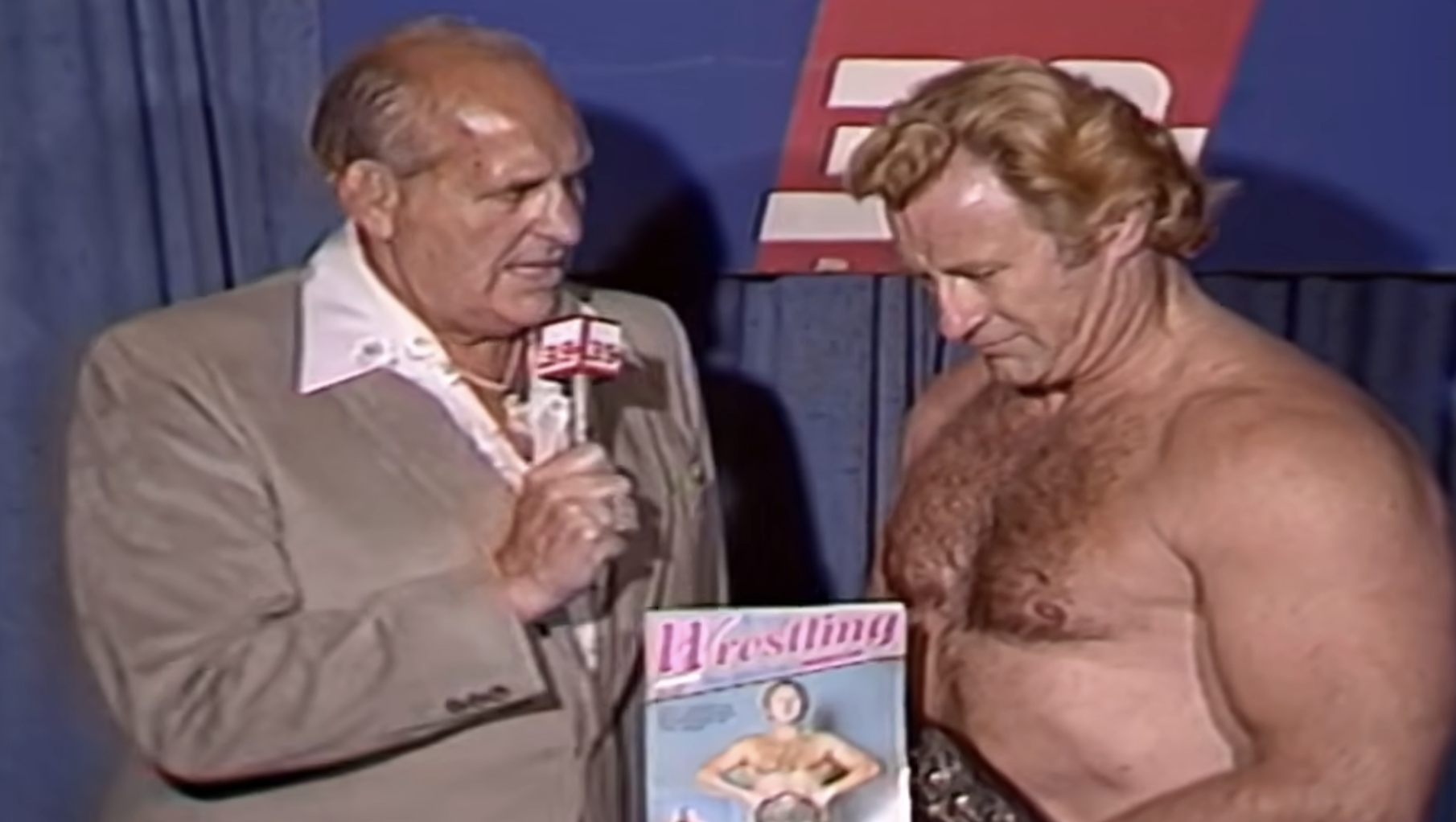
On May 20, 1983, Paul Boesch brought together two very different conceptions of a world champion at the Sam Houston Coliseum. Nick Bockwinkel arrived carrying the AWA World Heavyweight Championship, while Dusty Rhodes came to Houston as a two-time former NWA World Heavyweight Champion and one of wrestling’s great attractions. The match was presented accordingly: not as some incidental meeting between stars passing through Texas, but as a genuine interpromotional dream match on a card that also featured Bob Backlund defending the WWF Championship. It would also become the first part of a short Houston program between the two, eventually leading to a bull-rope rematch. Before any of that, though, there was the wonderfully simple proposition of putting wrestling’s self-styled aristocrat in the ring with the American Dream.
Even during the formalities before the match begins, Nick Bockwinkel and Dusty Rhodes conduct themselves differently. Nick indulges in the pleasantries of the handshake and small gestures of politeness, every bit the gentleman champion he styles himself to be. Dusty is looser. There’s an easygoing quality to him, but also a seriousness about the fight he’s about to be in. Bockwinkel looks like a man attending an important professional engagement. Dusty, on the other hand, is simply Dusty.
They spend a good part of the first half jockeying for control. Through a series of small skirmishes, holds and locks, Nick learns something with every repelled assault: Dusty is stronger and more explosive than he is. These aren’t holds for the sake of filling time, instead they’re little experiments, and Bockwinkel keeps receiving increasingly irritating results.
It doesn’t take much to disturb the gentlemanly atmosphere. Bockwinkel gets flustered when Dusty grabs him by the hair. It irritates him enough that he throws an ill-tempered punch, only for Dusty to counter and parlay it into a flurry of very zany-looking baby chops and distinctly Dustyesque blows. Nick tries to speak a rougher language and discovers, rather quickly, that Dusty is fluent.

Dusty struts around. For all his size and rotundness, there is an unmistakable air of coolness and sureness to his demeanor. Nothing about the man suggests embarrassment about being Dusty Rhodes. The belly, the strutting, the strange punches, the exaggerated movements—it all belongs together. He’s so cool he makes fat people want to stay fat. Every time I watch a Dusty match, I am reminded that we may be built the same, but he’s got that IT that big fellows like me do not possess. He’s so campy and built like a friend of Kirby that you almost forget he’s an incredible athlete. He played college baseball and college football, and just watching him go in the ring, you know that the song-and-dance routine is just good gravy poured over an already good piece of beef. It never ceases to wow me how he’s doing his hip-thrusting one minute and then in the next, he’s running the ropes for a mean shoulder tackle.
When Nick finally gets Dusty into a headlock, a grin breaks through his elitist mask. There’s something approaching enjoyment on his face. After all those failed attempts at imposing himself on Dusty, he finally has the big man contained on his own terms. For a moment, Bockwinkel appears to have caged Dusty’s thunder. Unfortunately for him, it doesn’t last. That collegiate power and explosiveness shine through here. Dusty breaks out of the headlock by running Nick into the ropes. He catches Bockwinkel on the return and humbles him with a bodyslam. It’s the simple joy of seeing a smug bastard get humbled by the everyman that makes professional wrestling so uniquely beautiful.
Bockwinkel remains obstinate even after the bodyslam and goes right back to Dusty’s arm, trying once again to lock him down. Dusty, no longer a stranger to Nick’s game plan, immediately uses his superior strength to crush Nick’s ego with a very emphatic delayed atomic drop. You can see the pain on Bockwinkel’s face, but the indignity is just as important. He’s being manhandled by some lout and that’s something he can’t fathom.
I love what happens next because Nick finally loses all pretense of elegance. He traps Dusty in the corner and starts whaling on him with punishing punches and vengeful kicks. Now Dusty feels something mortal. Now he’s hearing Nick speak to him in a language he understands.

Bockwinkel has always styled himself as a gentleman wrestler, someone above the dirt and grime of a brawl, but that doesn’t mean he can’t hold his own in a donnybrook. One of the reasons I personally enjoy Bockwinkel is that he does everything so beautifully. Whether he’s applying an arm lock or throwing a punch, everything he does looks worthy of being taught in some wrestling academy. Even when the veneer of sophistication disappears, the craftsmanship stays there in the fine print of his game. It’s like watching an NBA superstar do the little things, like hustle plays: they still do them in a picture-perfect way. Some people were just built to be stars and Nick is a natural at pro wrestling.
After laying it on Dusty, Nick tries to pin him. When that doesn’t work, a now visibly enraged Bockwinkel throws him out of the ring. He never chases him, though. Why should he? Nick has the high ground. Dusty is outside, the referee is counting, and the champion is exactly where a champion needs to be. The moment Dusty tries to come back through the ropes and break the count, Nick opportunistically attacks him. Nick really beats him up—nay, flogs his face, even.
Dusty isn’t having any of it, though. With a surge of newfound defiant power, he fights Nick back and pushes him toward the center of the ring. And now Bockwinkel gets the full Dusty course: the jiving, the shaking and, finally, a funky Bionic Elbow. Nick feeds Dusty beautifully, running right into his arms and really selling the futility of trying to match Dusty’s firepower.

Nick is close to being routed. He attempts a desperate counterattack, but Dusty has gotten inside his head. Bockwinkel isn’t fighting with the snooty poise he’s known for anymore. Eventually he makes a bad gamble: a falling knee from the ropes. He hits nothing but mat. It goes awry. These heated decisions usually do.
Now Dusty has all the cards while Nick has a bad knee. And Dusty, for all his commoner charm, is no less skilled in the finer points of wrestling. He immediately puts Bockwinkel into a Figure Four. Turnabout is such a bitch.
Now Nick is the one being worked, wrenched and pressured. The man who spent the opening minutes trying to contain Dusty in holds finds himself trapped by the supposed lout. It is painful. It is humiliating. But there is daylight for the AWA champion.
While thrashing around in pain, Bockwinkel catches the referee and knocks him down. That small unsupervised window is all Ted DiBiase needs. He enters the ring, attacks Dusty and leaves the challenger bloodied. Bockwinkel suddenly finds himself presented with something he had been unable to manufacture for himself: a way out of this fight, with his gold intact.
Fate smiles on Nick. He pins Dusty Rhodes and remains AWA World Heavyweight Champion.
This match tells a very beautiful narrative that takes its cue from the overall theme of the event: an interpromotional contest of styles. It would be too neat to say that Dusty and Bockwinkel represented the entirety of the NWA and AWA respectively—territory wrestling was far too varied for that—but the two men certainly arrived carrying very different traditions with them. Dusty was synonymous with the high-stakes drama and bloody spectacle of the NWA territories he inhabited. Bockwinkel carried himself with the realism and prestige associated with the AWA World Championship, where technical wrestling and the appearance of legitimate competition mattered enormously.
Both wrestlers represented something about the soul of those traditions. Nick Bockwinkel was a calculating and aristocratic heel who believed in the mythology of his own greatness and had the talent to back it up. His promos were well-mannered and well-spoken, always carrying an undercurrent of upper-class arrogance.
A week before the match, Nick practically laid this worldview out for Paul Boesch. He called the AWA Championship the zenith of the profession, described himself as the consummate athlete in the world and, when Boesch needled him about arrogance, argued that his accomplishments had earned him the right. That’s Bockwinkel in miniature. He doesn’t simply believe in his own boasts of greatness, he can will them to be facts, he can pull out the résumé and it is a very damn good one. He reminds me of Gunther in that both men treat the ring as a sacred institution and believe champions ought to conduct themselves in a certain way.
Dusty was the total opposite. He spoke like a common man and had a streetwise kind of moxie to him. He was built like some trucker living paycheck to paycheck. He brawled like your everyday Joe, but he could wrestle something cleaner when needed. He’s everything Bockwinkel looks down on, while Nick has exactly the sort of upper-class detachment that Dusty resents.
They bring all that baggage into the ring. Every time Dusty breaks free, overpowers him or refuses to stay contained, Nick gets a little less patient, while Dusty seems perfectly comfortable dragging the match further away from the controlled affair Bockwinkel wanted. Eventually that frustration costs Nick. The interesting part is that neither man really has to stop being himself. Dusty just survives long enough for the match to reveal that there’s more to both men than the roles they walked in playing.
Dusty is, as usual, so great at crowd control. He knows how to use his mannerisms to fire up the audience and convey that he’s having fun at the expense of his opponent’s dignity. It’s just as easy to appreciate Nick’s facial expressions. He can look annoyed, insulted or alarmed without ever crossing over into exaggeration. He reacts exactly the way you’d expect a champion with the last name of Bockwinkel to react.
This clash between Dusty and Bockwinkel works on two levels. The first is the obvious emotional one, where each man embodies a set of values that rubs against the other. Here, Dusty is your lovable goof, he’s supermarket Santa making the kids laugh. He’s your archetypical charming brute. Nick Bockwinkel with his surer-than-sure confidence and his big fancy AI-sounding words is also an archetype, he’s that magnificent bastard that you see in greater pop culture. He’s cultured and learned, and he’s a great wrestler and a polished promo on the mic. He’s everything you want in a hero except that he’s actually the villain in most of his matches. The clash between them hits the audience emotionally, it’s everything the fans identify with versus the things they identify against. It’s one of the oldest storytelling rules, and wrestling does it so well. And these guys are masters of that sort of emotional poking and prodding.

Now, the second level of an archetypal clash is when both archetypes subvert expectations by becoming a reflection of the other. A classic pop culture example is that part in Game of Thrones, when the forces of Daenerys start slaughtering people in King’s Landing and it’s actually the Lannister forces who try to save the civilians or buy them some time. Here, Dusty, who presents himself as an easygoing brawler, subverts expectations by showing that he can play Nick’s game when the opening presents itself. The Figure Four doesn’t suddenly make Dusty the better technician. What it proves, however, is that he understands the same logic Nick has spent the match trying to impose on him: find the weakness and seize it and make the other man deal with the consequences. Dusty is everything Nick declares himself to be in that moment, he is indomitable, resilient and noble in his own rough way. Nick, meanwhile, gets dragged into Dusty’s emotional terrain. He starts fighting angry, makes tactical errors and becomes reactive, even though the craftsmanship in what he does never really leaves him. Wrestling hits these more sublime moments when the two men who enter the ring leave it wearing each other’s faces. Fuck me, that’s such good shit.
What I like about this match is that it conveys the character of both men, and as the match progresses it also shows them turning into that thing they hate the most, which in that moment, is the opponent standing across from them. Could this match have used a little bit more time? Maybe. I would have loved to see the subverted archetypes fighting each other with Nick as the underdog heel versus Dusty as the overpowering face and then for them to end up back where they started with Nick regaining control of the match after almost losing it and Dusty coming from behind for the win. It might sound convoluted but I think that if anyone could pull off such layered storytelling, it’s these two men.
The match settles on a proven and pleasing parable: that of finding the inner grit to prevail against a foe who appears more sophisticated than you. It is a match built for Dusty, which makes sense in Houston, where the crowd is firmly behind the American Dream. Even the finish, although favoring Nick Bockwinkel, pivots the focus back toward Dusty and gives him another grievance with Ted DiBiase.
After all, it’s the twin golden rules of the territories: draw lots of money and protect your stars. Nick retains the honor of the AWA. Dusty rides off toward another red-hot fight with the audience wanting to see him get his hands on DiBiase. Everybody gets something out of the deal. And somewhere in all of this, we’ve learned a valuable lesson in life: you may not be the smartest and you may not be the best, but with enough earnest self-belief and some hip-jiving, you can make your way through the hard roads of the world.
★★★★¼ — 4.25 | Brilliance Restrained


Leave a Reply