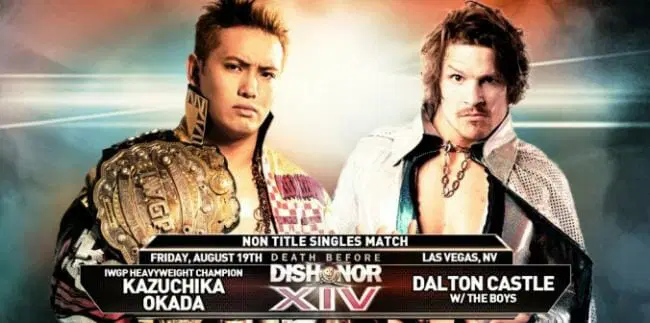
Sam’s Town Live — Las Vegas, Nevada
Non-title singles match
Dalton Castle is not a serious man.
He enters surrounded by Boys, struts around like an escaped peacock, and wrestles as though the entire building should consider itself fortunate to be in his presence. Put him opposite Kazuchika Okada, another wrestler who has never exactly suffered from a shortage of theatrical self-confidence, and you have two very different kinds of absurdity sharing the same ring. What makes the match work is that neither man allows the comedy to diminish the wrestling, which is very good here.
The Boys form a kind of running joke for the entire match. Okada is perfectly willing to play along (probably wanted it badly too), and Castle is more than fine being the Martin Short to Okada’s Steve Martin.
Castle’s gimmick has always threatened to obscure just how convincing he can be once he starts wrestling seriously. His amateur background comes through here in the way he controls and launches Okada, and his collection of suplexes gives the match considerably more physical credibility than all the pageantry surrounding it would suggest. The comedy never feels like an interruption because Castle does not suddenly become a different person when the bell rings. The same flamboyant lunatic commanding the Boys around ringside is also perfectly capable of dumping the IWGP Heavyweight Champion on his head.
But there’s also something to be said about how Castle makes himself a credible opponent through the wrestling itself. There’s an actual contest of physical ability going on here. Castle manages to get in some good knee strikes on Okada, and for all his wackiness, he’s very much aware that he can’t let Okada grab hold of his wrist. Castle manages to take the fight outside with a reversal that turns into a headscissors, followed by a suicide dive. This leads to an impressive stretch where he not only breaks Okada’s rhythm but goes on an offensive bender of his own. The shift in momentum on this bit was good enough to make me believe that the fans fanning him with fans are fanning him up, like some bubblegum blue Hogan. He can get Okada into positions where the bigger star has to struggle against him, and his strength gives those holds and throws some weight. His deadlift German suplex is especially good because Okada doesn’t simply fall into the move. Castle has to get hold of him, lift him, and complete the throw before bridging for the pin. It’s those little moments of a shocked Okada realizing that he’s going to land on his head that makes you appreciate Castle even more.
That’s something I look for when a bigger star is working with somebody lower on the card. It’s easy enough to let the other guy hit his moves. The more interesting question is whether you make him work for them, and whether those moves actually give you trouble.
Okada understands the assignment beautifully. He’s always had a ton of ham in him, and his genius is how he balances everything. He can pose with the Boys and play along with Castle’s humor without surrendering an ounce of his stature. Like, there are moments when he’s amused by the Boys, and there are moments when his face shows urgency just because Castle is getting a little too good for his taste. He is funny because he can be funny, but he can afford to be funny because he knows he is Kazuchika fucking Okada. Zeus can come down from Olympus and have a laugh with the mortals without anybody forgetting which one of them throws the lightning bolts.
And Okada actually does a pretty good job of recognizing Castle’s abilities. He struggles enough that Castle’s stuff looks well-earned. When Castle starts putting together some serious offense, Okada has to fight his way back into control while still playing with the semi-comedic tone of the match. There’s a nice spot involving the Boys themselves. Okada drags them into the ring and makes them fan Castle, before delivering his elbow drop. He then celebrates with them and gets them to do the Rainmaker pose. It’s a wonderfully stupid spectacle, especially when you remember that these two shirtless attendants are supposed to be working for the other guy. But all this fooling around also gives Castle an opportunity. Okada gets preoccupied with his song-and-dance routine, and this lets Castle get a hold of him.
The Bang-a-Rang is the best example. Castle actually lands it (I was delightfully shocked), but Okada has enough awareness to roll outside before Castle can capitalize. It is a clever way of giving Castle his biggest weapon without subjecting Okada to the ignominy of having to kick out. For all of Okada’s confidence and self-importance, he recognizes that getting pinned in Vegas would be a sucky way to conclude his American holiday. It was such a fucking well-timed spot because it puts the audience through a roller coaster of emotions: they go from laughing at Okada and the fanboys to being shocked that Castle nails him with the Bang-a-Rang, and then, in the split-second window where you expect Okada to be pinned, he rolls out, and it’s the most tantalizing thing ever.
This is where I think Okada deserves more credit. He is able to convey in this match that Castle can force him to make defensive decisions. He’s protecting himself from losing. And Castle doesn’t just stand there marinading in the moment. He sells his exhaustion intermingled with this sudden realization that maybe he can win. He follows Okada outside and brings him back into the ring to continue his attack. He even tries to secure another Bang-a-Rang. There’s some genuine pursuit going on here, and I applaud the consistency of the internal logic of the village goof having his day in the sun at the expense of the traveling hero.
But there is a difference between looking good and being an actual threat, and an even greater difference between becoming a threat for a moment and sustaining that threat long enough to change the complexion of a match. This is where I still have my reservations. Castle’s offense establishes competence and at least one genuine moment of danger, but it doesn’t create enough dramatic uncertainty for me. Even when Dalton strings together some great blows, it really only staggers Okada. For much of the match, Okada sells the experience gradually from mild surprise to growing urgency and concern. The escape to the floor is the clearest expression of that concern, but Castle never manages to keep Okada in that kind of trouble for very long. It’s still a tremendous achievement for the master of two half-naked men carrying enormous feather fans. But the hierarchy between them never really disappears. Zeus still calls the shots up in here.
And I think there’s something about how quickly Okada manages to restore that hierarchy once Castle’s second attempt at the Bang-a-Rang fails. Castle has already demonstrated that he can lift, throw and sometimes outmaneuver Okada, but he hasn’t developed much of an answer for what happens when Okada begins putting together his familiar finishing sequence. Castle is good at frustrating Okada whenever he tries to settle comfortably into his Rainmaker routine, but his offensive success doesn’t accumulate into a larger problem that Okada must spend the entire closing stretch solving. Once Okada gets his hands on the match again, he handily disposes of Castle with a Tombstone and his trusty finisher. The speed of it stands in contrast to the lengths Castle went to just to threaten him.
The fog clears and once again we can see with our own eyes Zeus standing across from a mere man.
I suppose the next question is how far a superior wrestler ought to go in making his opponent look like a believable challenger. Okada certainly lets Castle look good. He even makes him look dangerous in places in this match. But Castle never quite reaches the point where Okada must fundamentally abandon his familiar methods to survive him. The match elevates Castle’s credibility as a wrestler without doing much to change what we already believe about the two men’s relative standing. Which is fine. Not every visiting Japanese champion needs to be brought to the brink of death by the local jester.
The nice blend of comedic timing and serious offense makes this an above-average match, even if it never generates enough uncertainty or emotional weight to become anything more. I laughed, but I sure as shit did not cry.
★★★¼ — 3.25 — Mechanics Elevated


Leave a Reply